
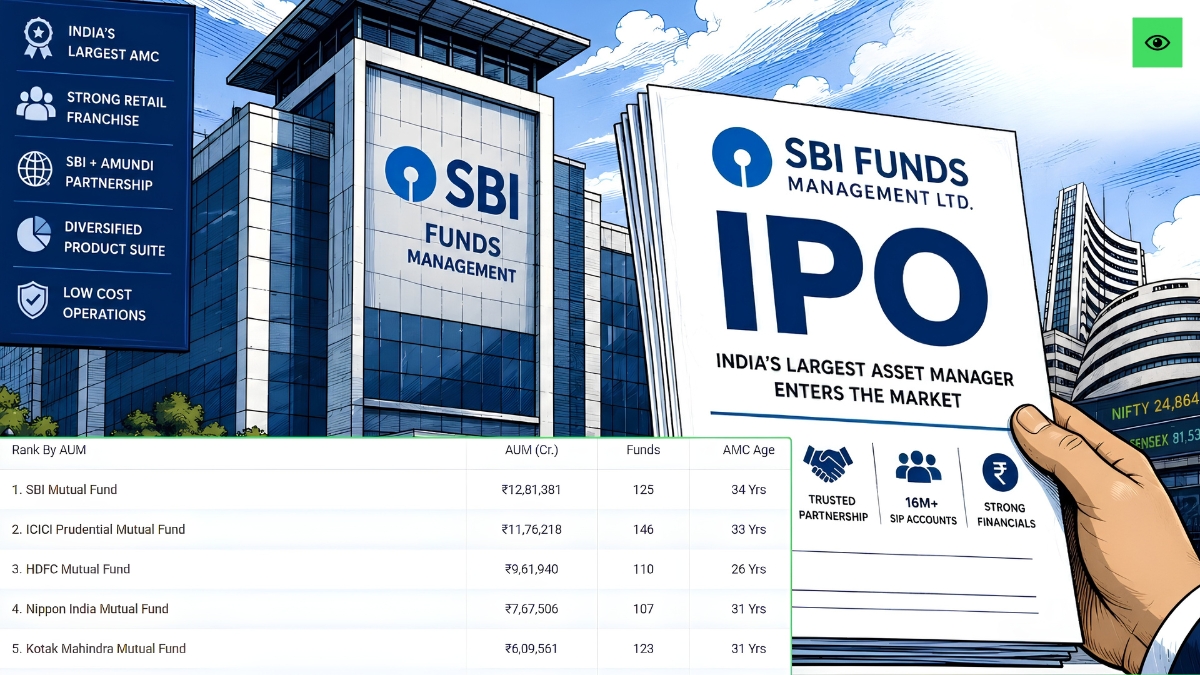
New Delhi, 15.07.2026: Some companies become market leaders because they invent something extraordinary. Others quietly dominate industries that keep expanding year after year. SBI Funds Management belongs to the second category. It isn’t chasing hype or promising futuristic breakthroughs. It simply manages money. And it does that at a scale few companies in India can match.

The real question isn’t whether it’s a good business. The real question is whether it’s a good investment at the price being offered.
Understanding the Business
At its core, SBI Funds Management earns money by managing investments on behalf of individuals and institutions. Investors park their money in mutual funds, portfolio management services, alternative investment funds and advisory products. In return, the company charges a management fee.
It sounds simple because it is.
Imagine the company manages ₹1 lakh crore. Even if the average fee is just half a percent annually, that’s roughly ₹500 crore in revenue. Now double the assets. Revenue rises sharply, but expenses don’t increase at the same pace.
That’s the beauty of the asset management business.
Unlike manufacturing companies, it doesn’t need new factories every time it grows. Unlike banks, it doesn’t have to lend its own money. The infrastructure already exists. Growth mainly comes from attracting more investors and increasing the assets under management.
This operating leverage is one of the biggest reasons why leading asset management companies consistently report healthy profits.
Why SBI Funds Management Is Different
Every mutual fund house offers investment schemes. Very few enjoy the structural advantages available to SBI Funds Management.
The biggest advantage is trust.
State Bank of India already serves millions of Indians through savings accounts, fixed deposits, loans and digital banking. That relationship makes it much easier to introduce investment products to existing customers than starting from scratch.
The company’s integration with SBI’s YONO platform further strengthens this advantage. Customers can increasingly begin their investment journey without switching to another ecosystem or dealing with complicated paperwork.
Then comes its second pillar.
Amundi, one of the world’s largest asset managers, brings international expertise, research capabilities and global best practices to the partnership. Very few Indian fund houses enjoy the combined backing of India’s largest bank and one of Europe’s biggest investment managers.
That combination creates a competitive position that isn’t easy to replicate.
An Industry With Room to Grow
India’s mutual fund industry is still in its early stages compared to developed economies.
A significant portion of household savings continues flowing into traditional assets such as gold, real estate, fixed deposits and cash. Financial habits, however, are steadily changing.
Young investors are embracing systematic investment plans, better known as SIPs. Instead of making occasional lump sum investments, they invest every month.
That consistency benefits everyone involved.
Investors build long-term wealth while asset managers receive recurring inflows and predictable fee income.
SBI Funds Management has become one of the biggest beneficiaries of this structural shift. According to the prospectus, it manages more than 16 million live SIP accounts, with a large proportion remaining active for over three years. That suggests investors are staying invested instead of treating mutual funds as short-term experiments.
Long-term customers are the foundation of every successful asset management business.
Growth Drivers
Several long-term trends continue working in SBI Funds Management’s favour.
Rising incomes are increasing household savings. Once emergency funds are built, families naturally begin looking for investment options capable of delivering better long-term returns than traditional savings products.
Financial awareness has also improved dramatically. A decade ago, many retail investors viewed mutual funds with caution. Today, SIPs have become part of mainstream financial planning, supported by investor education, digital platforms and growing market participation.
Technology is another powerful catalyst.
Opening a mutual fund account once involved lengthy paperwork. Today, digital onboarding allows investors to begin within minutes, making investing accessible even in smaller cities.
Finally, Indian households are slowly moving beyond fixed deposits as their primary investment choice. Inflation has encouraged many investors to diversify towards market-linked products capable of creating long-term wealth.
Each of these trends supports the continued expansion of the mutual fund industry, creating a favourable environment for established players like SBI Funds Management.
Competitive Advantages That Matter
SBI Funds Management enjoys several strengths that competitors will find difficult to copy.
Brand Trust
Money follows trust.
People hand over their life savings only to institutions they believe will remain stable for decades. SBI has spent generations building that credibility. During periods of market uncertainty, investors often prefer established names over unfamiliar ones. That trust isn’t created overnight. It takes decades.
Distribution Network
Perhaps the company’s biggest edge is its access to SBI’s nationwide banking network.
Most asset management companies spend heavily on distributors, financial advisors and advertising to acquire customers. SBI Funds Management starts with millions of existing banking relationships across urban and rural India.
That’s not just a competitive advantage. It’s an economic moat.
Scale Creates Efficiency
Size matters in asset management.
Managing the country’s largest pool of assets allows the company to spread technology, compliance and research costs across a much larger base. Fund managers have better access to research, stronger analytical resources and greater operational efficiency.
Scale also improves profitability.
It’s a cycle that feeds itself. Larger assets generate higher revenue. Higher revenue funds better technology and research. Better services attract more investors. More investors increase assets further.
Lower Operating Costs
The prospectus highlights another important point.
Among India’s leading asset managers, SBI Funds Management reports one of the lowest operating expense ratios. Simply put, it spends less to manage every rupee entrusted by investors than many competitors.
Lower operating costs translate directly into stronger margins.
In a business where fee structures are constantly under pressure, efficiency becomes a significant long-term advantage.
A Sticky Customer Base
One of the most underrated strengths of the business isn’t financial. It’s behavioural.
Once investors begin monthly SIPs, most continue them unless forced to stop due to financial hardship. That creates recurring inflows every month.
Recurring inflows create recurring management fees.
Recurring fees create predictable earnings.
Predictable earnings usually command better market valuations because investors appreciate businesses capable of delivering stable cash flows across different economic cycles.
Looking Beyond the Story
Every IPO arrives with an attractive narrative.
Some promise artificial intelligence. Others speak endlessly about disruption or rapid expansion.
Professional investors ignore most of that noise.
Instead, they ask a handful of simple questions.
Is revenue growing consistently?
Are profits improving?
Does the company generate real cash?
Can it grow without constantly asking shareholders for more money?
SBI Funds Management performs well across all these parameters.
Revenue Quality
The quality of revenue often matters more than the quantity.
Many businesses rely on customers repeatedly making buying decisions. When demand slows, sales fall immediately.
This business works differently.
As long as investors keep their money invested, SBI Funds Management continues earning management fees year after year.
Imagine an investor starts a ₹10,000 monthly SIP and continues investing for twenty years.
The company doesn’t need to sell the product again every year. It simply continues earning recurring income as assets remain invested.
Now multiply that by millions of investors.
That’s what makes the revenue base remarkably stable.
Profitability
Revenue alone doesn’t define a great business.
The real question is how much of that revenue becomes profit.
SBI Funds Management benefits from an asset-light model.
It doesn’t manufacture products.
It doesn’t operate factories.
It doesn’t finance loans like a bank.
Its primary investments are people, research, compliance and technology.
As assets under management grow, these costs increase much more slowly than revenue. That naturally expands profitability over time.
It’s one of the strongest characteristics of the asset management industry.
Cash Generation
Another encouraging aspect is cash flow.
Some businesses report accounting profits but struggle to convert those profits into actual cash.
That’s far less of a concern here.
Management fees are collected regularly. Capital expenditure remains modest. There are no inventories piling up and no expensive production facilities demanding continuous investment.
As a result, accounting profits closely resemble real cash generation.
High-quality earnings often deserve premium valuations because they are easier to sustain over long periods.
Return on Capital
Perhaps the most impressive financial characteristic is return on capital.
In simple terms, it measures how efficiently a company converts invested capital into profits.
Businesses requiring enormous investment just to maintain growth often struggle to create long-term shareholder wealth.
Asset management companies are different.
Growth doesn’t require massive capital expenditure.
That allows them to generate attractive returns while remaining financially efficient.
It’s exactly the kind of business model long-term investors tend to appreciate.
Growth Drivers Ahead
Future growth is likely to come from several directions.
First, millions of Indians have still not entered the mutual fund ecosystem. Every first-time investor represents a new opportunity.
Second, existing investors usually increase their SIP contributions as their incomes rise. Someone investing ₹500 today may comfortably invest ₹5,000 a few years later.
Third, rising equity markets naturally increase the value of assets under management, leading to higher fee income without acquiring a single new customer.
Finally, the industry itself continues evolving through passive investing, exchange traded funds, retirement products, wealth management and alternative investments.
SBI Funds Management already operates across many of these segments, giving it multiple opportunities to deepen relationships with existing clients while attracting new ones.
Management and Governance
Asset management is ultimately a people business.
Investors don’t hand over their money because of glossy advertisements. They invest because they believe the people managing that money know what they’re doing.
According to the prospectus, SBI Funds Management has built an experienced investment team with professionals who have spent years within the organisation. That continuity matters. Frequent leadership changes often create uncertainty. Stability usually translates into consistency.
The company also benefits from institutional ownership through State Bank of India and Amundi. Both are established financial institutions with decades of operating history.
Does that eliminate governance risk?
No.
No listed company is completely immune from governance challenges.
But compared with many IPOs promoted by relatively unknown founders, SBI Funds Management starts from a position of significantly higher institutional credibility.
What I Like Most
Several aspects stood out while analysing the business.
Market Leadership
Being India’s largest asset manager isn’t just a title.
Large institutions prefer established players. Distributors naturally gravitate towards companies with proven performance. Talented professionals often choose market leaders because of better opportunities and resources.
Leadership creates momentum.
Momentum attracts more business.
Strong Brand Recall
Financial services are built on confidence.
When markets become volatile, investors usually don’t experiment with unknown names. They gravitate towards institutions they already trust.
SBI enjoys one of the strongest financial brands in the country.
That trust becomes particularly valuable during uncertain market conditions.
Distribution Advantage
Building a nationwide distribution network from scratch would take years and enormous investment.
SBI Funds Management already has access to one through the SBI banking ecosystem.
Millions of customers walk into SBI branches every day.
Many already use YONO and other digital banking services.
Cross-selling investment products becomes significantly easier when customer relationships already exist.
This remains one of the company’s biggest competitive strengths.
Industry Tailwinds
India’s mutual fund industry continues expanding.
Household savings are gradually moving away from traditional assets towards market-linked investments.
Financial awareness is improving.
Digital investing is becoming easier.
Young professionals are beginning SIPs much earlier than previous generations.
These aren’t temporary trends.
They’re structural changes likely to support the industry for many years.
Diversified Revenue Streams
Another positive is diversification.
The company isn’t dependent on one star fund or one customer segment.
Revenue comes from equity funds, debt funds, hybrid products, exchange traded funds, portfolio management services, alternative investment funds and advisory businesses.
Diversification reduces concentration risk while providing multiple avenues for future growth.
What Concerns Me
No investment is perfect.
Ignoring risks simply because a business looks attractive is one of the fastest ways to make expensive mistakes.
This IPO Doesn’t Raise Capital
The first concern is the IPO structure itself.
This is entirely an Offer for Sale.
The proceeds won’t be used to expand the business, repay debt or invest in new initiatives.
Instead, existing shareholders are partially reducing their stake.
That isn’t necessarily negative.
The company doesn’t require large amounts of capital to grow because of its asset-light model.
Still, investors should recognise they’re purchasing shares from existing owners rather than financing future expansion.
Dependence on Market Performance
Asset management companies naturally depend on financial markets.
When markets perform well, assets under management increase.
When markets decline sharply, portfolio values fall.
Lower assets translate into lower management fees.
During prolonged bear markets, new investments also tend to slow as investor confidence weakens.
The business remains profitable, but earnings growth may moderate.
Regulatory Risk
Financial services operate within a tightly regulated environment.
The Securities and Exchange Board of India regularly reviews industry practices, fee structures, disclosure norms and distribution policies.
Any meaningful regulatory changes could influence profitability across the sector.
This isn’t unique to SBI Funds Management.
It’s an industry-wide risk every investor should keep in mind.
Competition Is Intensifying
The mutual fund industry isn’t standing still.
- Passive investing continues gaining popularity.
- Exchange traded funds generally charge lower fees.
- Digital investment platforms are lowering customer acquisition barriers.
- Wealth management firms continue entering the market.
SBI Funds Management enjoys significant competitive advantages today, but no company can assume its leadership position will remain unchallenged forever.
Valuation Risk
This is where I become cautious.
High-quality businesses often command premium valuations.
That’s perfectly reasonable.
The problem begins when investors convince themselves that any price is acceptable simply because the company is excellent.
History tells a different story.
Even outstanding businesses can generate disappointing investment returns if purchased at excessive valuations.
That’s why the valuation deserves as much attention as the business itself.
Reading Between the Lines
One interesting observation while studying the prospectus is what receives the most attention.
Management highlights:
• Market leadership
• Distribution strength
• Digital integration
• Operational efficiency
• Scale
• Retail SIP franchise
All genuine strengths.
At the same time, naturally, there is less emphasis on issues such as increasing fee pressure, the rise of passive investing, competition from digital wealth platforms and slower inflows during prolonged market corrections.
That’s normal.
Every prospectus presents the company’s strongest case.
It’s the investor’s responsibility to evaluate both the opportunities and the risks before making a decision.
Overall Financial Assessment
After reviewing the business model, competitive positioning and financial characteristics, one conclusion becomes fairly obvious.
SBI Funds Management isn’t a hyper-growth story.
It’s a high-quality compounding business.
There’s an important difference.
Hyper-growth companies often rely on aggressive expansion and uncertain profitability.
Compounding businesses steadily increase earnings over long periods while generating healthy cash flows and maintaining strong margins.
SBI Funds Management fits the second category.
Its business quality is difficult to question.
The only question left is whether investors are being asked to pay a reasonable price.
That is exactly where the investment decision ultimately rests.
By now, one thing should be clear.
SBI Funds Management is a very good business.
The harder question is whether it’s a very good investment at the IPO price.
That’s where investors need discipline.
A wonderful company bought at an unreasonable valuation can produce mediocre returns. On the other hand, a great business purchased at a sensible price can quietly build wealth for years.
The IPO has been priced in the range of ₹545 to ₹574 per share. At the upper end, investors are paying a premium for market leadership, profitability, brand strength and long-term growth prospects.
Is that justified?
To an extent, yes.
The company is India’s largest asset manager. It has strong profitability, recurring revenue, an asset-light business model and two respected promoters in SBI and Amundi. Those characteristics deserve better valuations than average financial companies.
But premium businesses almost always leave less room for error.
If earnings continue growing steadily, today’s valuation may look reasonable several years down the line. However, if equity markets remain weak, fee pressure increases or regulations tighten, returns could fall short of expectations despite the business remaining fundamentally strong.
What Could Go Right
Several long-term factors could support the company over the coming decade.
India’s Mutual Fund Industry Is Still Under-penetrated
Compared with developed economies, Indian households still allocate a relatively small portion of their wealth to market-linked financial products.
As awareness improves and disposable incomes rise, mutual funds are likely to capture a larger share of household savings.
That creates a long runway for growth.
SIP Culture Is Becoming Permanent
One of the biggest structural changes in Indian investing is the rise of Systematic Investment Plans.
Young professionals are no longer waiting until middle age to begin investing. Many start with their very first salary.
That creates predictable monthly inflows for fund houses.
SBI Funds Management already operates one of the country’s largest SIP franchises, putting it in an advantageous position as this trend continues.
The SBI Ecosystem
Very few competitors enjoy direct access to one of India’s largest banking networks.
Cross-selling investment products to millions of existing SBI customers reduces customer acquisition costs while increasing distribution efficiency.
This remains one of the company’s strongest competitive advantages.
Digital Expansion
Digital investing continues making mutual funds accessible across smaller cities and younger demographics.
Platforms like YONO simplify onboarding and encourage first-time investors to begin investing with minimal friction.
Lower costs and wider accessibility should support long-term scalability.
International Opportunities
The partnership with Amundi opens additional opportunities beyond domestic markets.
As global investors continue increasing exposure to India, international advisory mandates and offshore investment products could become incremental growth drivers.
What Could Go Wrong
Every investment comes with risks.
Ignoring them simply because the company is well known would be a mistake.
Extended Bear Markets
This remains the biggest business risk.
Management fees are linked directly to assets under management.
When equity markets decline sharply:
• Portfolio values fall.
• Investor confidence weakens.
• New inflows slow.
• Revenue growth moderates.
The company is unlikely to become unprofitable, but earnings growth can slow meaningfully during prolonged market downturns.
Fee Compression
Asset management has become increasingly competitive worldwide.
Passive funds and exchange traded funds generally charge lower fees than actively managed products.
If pricing pressure intensifies in India, industry profitability could gradually decline.
Regulatory Changes
SEBI periodically reviews fee structures, distribution commissions and disclosure requirements.
While these changes are designed to protect investors, they can also reduce profitability for asset management companies.
This remains a sector-wide risk rather than a company-specific issue.
Reputation Risk
Trust is everything in financial services.
A major governance lapse, compliance issue or prolonged period of poor investment performance could affect investor confidence.
Although the risk appears low today, it should never be ignored.
Who Should Consider This IPO?
Long-Term Investors
Yes.
If your investment horizon is five years or longer, SBI Funds Management deserves serious attention.
The mutual fund industry itself is expected to expand significantly over the coming decade, and the company is well placed to benefit from that growth.
Listing Gain Investors
Proceed carefully.
Strong businesses often attract healthy subscription numbers, but listing gains depend far more on market sentiment than business quality.
Nobody can reliably predict short-term listing performance.
Conservative Investors
Yes.
Compared with many recent IPOs, SBI Funds Management represents a mature, profitable and well-established business with a long operating history.
That reduces business risk considerably.
Short-Term Traders
Probably not.
The company’s appeal lies in steady long-term compounding rather than speculative short-term price movements.
Investment Verdict
If I were evaluating this purely as a long-term investment, my conclusion would be straightforward.
I would be comfortable owning the business.
What I wouldn’t do is ignore valuation.
Business quality should never be confused with investment quality.
The company possesses almost everything long-term investors typically seek:
• Market leadership.
• Strong brand recognition.
• Asset-light operations.
• High-quality recurring revenue.
• Healthy profitability.
• Excellent cash generation.
• Structural industry tailwinds.
Those strengths are real.
However, the IPO is entirely an Offer for Sale. The company itself is not raising fresh capital, and investors are purchasing shares from existing shareholders. That doesn’t weaken the business, but it does mean future returns will depend largely on earnings growth and valuation rather than capital deployment from the IPO proceeds.
Investment Scorecard
Business Quality: 9.5/10
India’s largest asset manager with durable competitive advantages and a strong industry position.
Financial Strength: 9/10
High-quality earnings, robust cash generation and an asset-light business model.
Management & Governance: 9/10
Backed by two globally respected financial institutions with established governance standards.
Growth Potential: 8.5/10
Long-term industry tailwinds remain favourable, although growth is likely to become steadier as the business matures.
Risk Level: 4/10
The principal risks are valuation, regulation and market cycles rather than the business itself.
IPO Attractiveness: 8.5/10
An attractive offering for investors focused on long-term wealth creation, provided expectations remain realistic and the valuation leaves sufficient room for future returns.
SBI Funds Management is not trying to convince investors that it might become a great company someday.
It already is one.
Its leadership position, trusted brand, recurring revenue model, nationwide distribution network and disciplined business model make it one of the strongest franchises in India’s financial services sector.
That said, investing is never just about buying a great company.
It’s about buying a great company at the right price.
For investors seeking quick listing gains, there’s no certainty.
For investors building a portfolio for the next decade, SBI Funds Management deserves a place on the watchlist and, if the valuation is reasonable, serious consideration.
In one sentence, the investment thesis is simple:
SBI Funds Management isn’t worth buying because it’s an IPO. It’s worth considering because it has the characteristics of a business capable of compounding shareholder wealth for many years, provided investors remain disciplined about the price they pay.
The most sensible approach is neither blind optimism nor unnecessary pessimism. Recognise the strength of the franchise, assess the valuation objectively and invest only if the expected long-term return justifies the price being paid.
Disclaimer This article does not constitute investment advice, a recommendation to buy or sell securities, or financial planning guidance. Investors should read the official prospectus, evaluate their own financial circumstances and consult a SEBI-registered investment advisor before making any investment decisions.

Any Comments?