
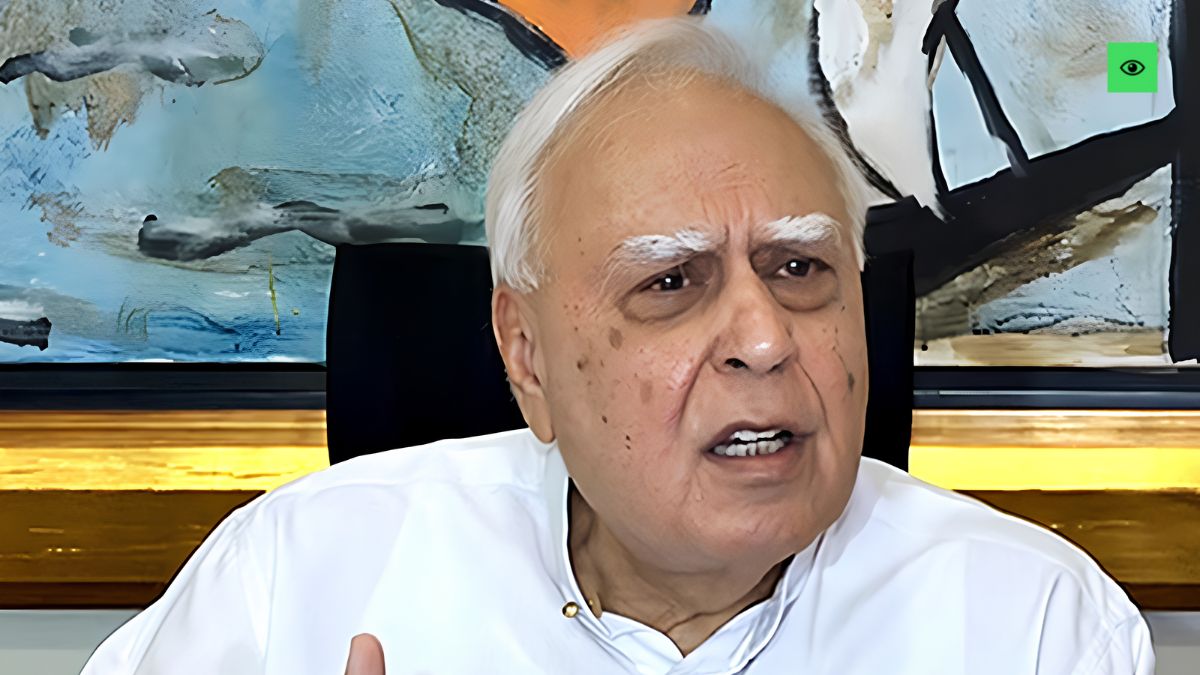
NEW DELHI, 24th Oct: Congress leader and Rajya Sabha MP Kapil Sibal has challenged RSS chief Mohan Bhagwat’s remarks on regime change, arguing that India’s political future must be decided through democratic means. His response also raises questions about peaceful protests, unemployment, alleged border incursions and the country’s diplomatic priorities.
The political exchange puts a familiar but important issue back in focus: who gets to define dissent, and what happens when criticism of the government becomes a question of national loyalty?
Kapil Sibal Slams Mohan Bhagwat Over Democratic Change
Kapil Sibal criticised Bhagwat’s Vijayadashami address delivered on October 20, in which the RSS chief spoke about alleged attempts to weaken India, Hindus and the Sangh. Bhagwat also referred to efforts to change governments and compared developments in India with unrest in countries including Nepal, Bangladesh and France.
Sibal rejected that comparison, arguing that a change of government through democratic means is fundamentally different from a violent uprising.
“What India wants is a change of government through democratic means,” Sibal said, adding that Bhagwat understood this distinction but was unwilling to acknowledge it.
His argument centres on a basic principle of parliamentary democracy. Governments can face criticism, opposition parties can seek their removal, and citizens can demand political change without necessarily challenging the constitutional order.
The distinction matters because political disagreement and attempts to destabilise a country are not interchangeable concepts. Establishing a connection between the two requires evidence, not merely a comparison with events elsewhere.
Peaceful Protests and the Question of Foreign Influence
Sibal also challenged the suggestion that protests in India could be compared with violent unrest overseas.
Referring to demonstrations at Jantar Mantar, he said young protesters had gathered peacefully and resorted to hunger strikes rather than carrying weapons or throwing stones.
He also alleged that any violence associated with the unrest had been caused by outside agencies. Pointing to a truck reportedly found carrying stones, Sibal questioned whether authorities had investigated its origin.
These allegations remain Sibal’s claims. Establishing responsibility for any violence requires an independent investigation and verifiable evidence.
His broader question, however, concerns the treatment of dissent. When citizens protest against government decisions, authorities must distinguish peaceful political expression from criminal conduct. The same standard should apply regardless of the political identity of the protesters.
Sibal also questioned the suggestion that foreign forces were responsible for public dissatisfaction.
He pointed to unemployment among middle-class young people and the lack of opportunities available to poorer citizens. His argument was that domestic economic grievances cannot simply be dismissed by attributing dissent to external influence.
That is a debate worth examining through employment data, economic conditions and the specific evidence behind allegations of foreign interference.
RSS, Political Power and the Charge of Selective Criticism
Sibal questioned the RSS’s position on political change, arguing that the organisation had itself participated in a previous shift in power.
He referred to the RSS’s support for Arvind Kejriwal and the subsequent decline of the Congress-led United Progressive Alliance government. He also argued that the organisation’s relationship with the current political establishment created a conflict of interest.
According to Sibal, the RSS has avoided criticising the Narendra Modi government and state governments where its political allies hold power.
He also accused the government of changing the style of governance since 2014, citing arrests of young people and opposition leaders, the alleged misuse of gubernatorial offices and attempts to destabilise elected governments.
These are political allegations, not findings established by the remarks alone. Assessing them requires examining individual cases, the legal grounds for arrests, the constitutional role of governors and the circumstances surrounding changes in state governments.
Still, Sibal’s central challenge is clear: if political organisations defend democratic accountability, that principle should apply to governments they support as well as those they oppose.
Consistency is the real test of any political argument. The principle means little if it changes depending on who occupies the seat of power.
Education, Unemployment and the Issues Sibal Says Are Being Ignored
Sibal argued that the political debate was diverting attention from problems affecting ordinary Indians.
He referred to concerns about the condition of the school system, saying that educational deficiencies had been highlighted through visits to schools. He criticised Bhagwat for allegedly remaining silent on these issues.
He also returned to unemployment and unequal access to economic opportunities, arguing that these grievances were sufficient to explain why citizens might oppose the government.
The questions surrounding education and employment deserve more than political sound bites. They require evidence about learning outcomes, school infrastructure, job creation, wages and access to opportunities.
Sibal’s remarks frame these issues as a test of political priorities. If national debates focus heavily on ideological conflict, citizens may reasonably ask whether governments and influential organisations are paying enough attention to the services and opportunities that shape everyday life.
The relevant test is measurable progress, not the volume of political speeches.
Arunachal Pradesh and the ITBP Statement
Sibal also raised concerns about a statement attributed to the Director General of the Indo-Tibetan Border Police, or ITBP, concerning skirmishes in Arunachal Pradesh and the possible occupation of Indian territory by China.
He alleged that the statement had been removed from YouTube and argued that deleting a video would not resolve the underlying security concerns.
“You can remove his statement from YouTube. You can’t remove those people who have occupied our territory,” Sibal said.
He also questioned why the RSS had not spoken more forcefully about alleged incursions in Arunachal Pradesh and eastern Ladakh.
The issue involves two separate questions: what the ITBP chief actually said, and what evidence exists regarding the alleged territorial developments.
Both require careful verification. The removal of a video, if confirmed, would not by itself establish the accuracy of every claim made in it. Equally, questions about border security should be addressed through credible information and official clarification rather than dismissed as partisan rhetoric.
For India, border security is a matter of national interest. Public scrutiny of official statements and government responses is part of that discussion, provided allegations are clearly distinguished from verified facts.
Marco Rubio’s Visit and India’s Diplomatic Choices
Sibal also criticised the reported itinerary of US Secretary of State Marco Rubio, referring to visits involving Mumbai and Jamnagar and a reported $300 billion announcement.
He questioned the diplomatic significance of the visit and compared the arrangement with a hypothetical situation in which India’s external affairs minister travelled to an American state while the US secretary of state declined to meet the president.
Sibal described the arrangement as demeaning and questioned what the announcement that 99 per cent of a trade deal had been completed meant for India’s ability to determine its own economic direction.
His comments raise questions about diplomatic protocol, trade negotiations and the public communication of major economic agreements.
However, evaluating the significance of a diplomatic visit requires the full itinerary, the purpose of the meetings, the status of negotiations and the precise nature of any financial announcement. A reported investment figure, a trade commitment and a completed agreement are not necessarily the same thing.
India’s diplomatic standing cannot be assessed through optics alone. The substance of agreements, their enforceability and their consequences for Indian businesses and workers matter just as much.
The 57 FIRs and Sibal’s Warning About Political Targeting
Sibal also addressed 57 first information reports reportedly registered between October 2 and 23 and transferred to the Crime Branch. He said some named opposition leaders, while others initially identified no accused.
He alleged that police sometimes register an FIR without naming a suspect, collect statements and subsequently introduce the names of people they want to target.
Sibal argued that such practices create fear among political opponents. He added that courts remained available to examine the cases and expressed confidence in the judicial process.
These allegations require examination of the individual FIRs, the evidence collected and the legal procedures followed by investigators. The number of cases alone does not establish political targeting, just as the registration of an FIR does not establish guilt.
The principle at stake is straightforward. Investigations must follow the law, evidence must support allegations, and the accused must receive the protections guaranteed by due process.
Courts play a central role in determining whether those standards have been met.
Bhagwat’s Vijayadashami Speech and the Debate Over Nationalism
Bhagwat’s address presented the RSS chief’s concerns about forces he described as seeking to weaken India, Hindus and the organisation. He also warned against political actions that could divide society.
Sibal responded by challenging the priorities behind that message. He questioned the focus on alleged external forces while pointing to education, employment, border security and the conduct of government institutions.
He also referred to Bhagwat’s earlier reported remarks linking the consecration of the Ram Mandir with India’s attainment of real independence. Sibal used that statement to question the political and social outcomes associated with the claim.
The exchange illustrates a wider disagreement over nationalism and political accountability. One side emphasises perceived threats to national unity and cultural identity. The other, in Sibal’s framing, argues that democratic rights, economic opportunity and institutional accountability deserve equal attention.
Neither argument settles the underlying questions on its own. The claims need to be assessed individually, with evidence and constitutional principles providing the standard.
Democratic Change Requires Evidence and Accountability
Kapil Sibal’s response to Mohan Bhagwat’s Vijayadashami address covered far more than a disagreement over regime change. It brought together questions about peaceful protest, unemployment, education, border security, diplomatic protocol and the use of investigative powers.
His closing prediction was that Indians had decided change would come peacefully, although the timing and form of any political change remain uncertain.
The larger issue is how political leaders and institutions respond to criticism. Peaceful dissent should not automatically be equated with destabilisation, and allegations of wrongdoing should not be treated as established facts without evidence.
The same standard must apply to governments, opposition parties and influential organisations.
Democracy does not require everyone to agree. It requires institutions to function, evidence to matter and citizens to retain the right to question those who exercise power.
The most important aspect of the Kapil Sibal and Mohan Bhagwat exchange is the distinction between political dissent and threats to national stability. A democracy must be able to accommodate peaceful protests, opposition campaigns and demands for a change of government without automatically treating them as evidence of foreign interference. At the same time, allegations of political targeting, territorial incursions or institutional misconduct must be supported by verifiable evidence. Sibal’s remarks raise questions about education, employment, law enforcement and diplomatic priorities, all of which deserve scrutiny beyond party lines. The sensible approach is to examine each claim on its merits, demand transparency from public institutions and apply the same standards to the government, the opposition and influential organisations. Political rhetoric can start a debate. Evidence must determine where that debate leads.

Any Comments?