
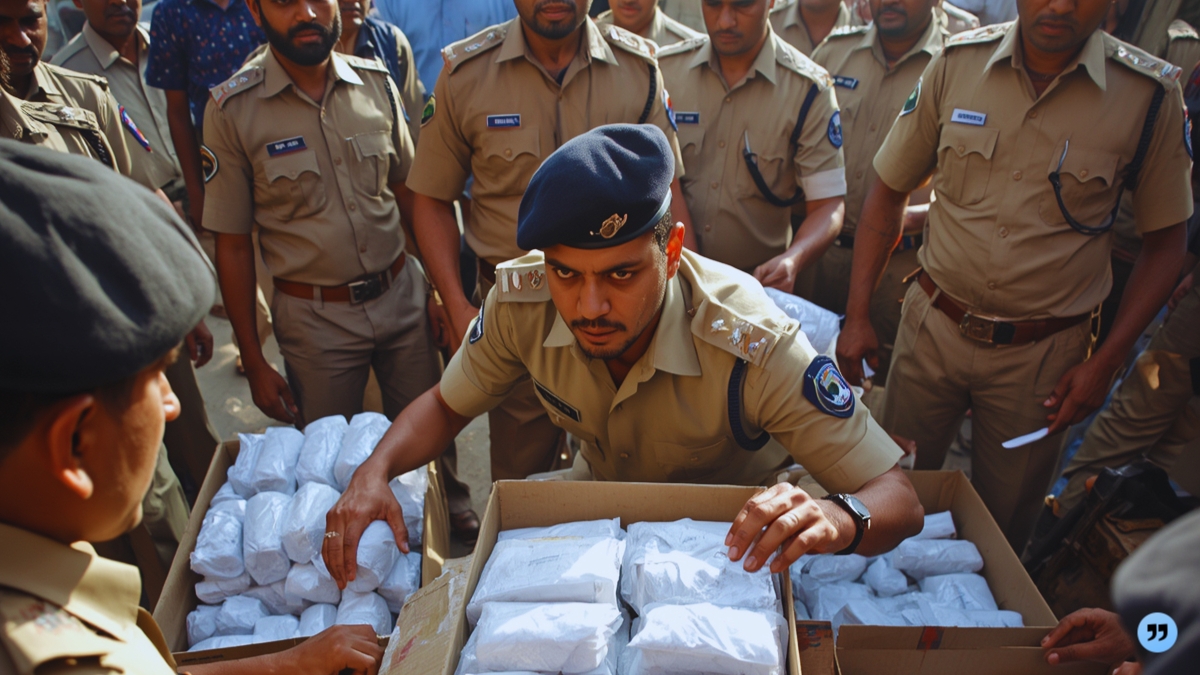
20/05/26: The Bengaluru MDMA racket just ran into a wall called coordinated police work. In one of the city’s biggest narcotics crackdowns in recent years, Bengaluru Police seized 17.5 kg of MDMA worth nearly Rs 35 crore and arrested eight accused tied to an interstate synthetic drug network.
For a city increasingly battling designer drug circulation, this wasn’t a routine bust. It was a layered operation that stretched from Bengaluru to Delhi and Haryana.
Bengaluru Police Crack Multi-State MDMA Supply Chain

Police Commissioner Seemant Kumar Singh described the operation as one of the largest drug seizures carried out by the city police in recent years. The crackdown was supervised by Joint Commissioner of Police C Vamsi Krishna.
The Bengaluru MDMA racket investigation began after police cracked a narcotics case in Yeshwanthpur earlier, where nine people had already been arrested. Investigators say that probe opened the door to a much wider interstate network dealing in synthetic drugs sourced from north India and routed into Bengaluru for high-margin sales.
And that’s the thing about organized narcotics networks. Nobody moves 17.5 kg of MDMA like it’s courier luggage. These operations are layered, distributed, and financially engineered.
Police say they followed the breadcrumbs carefully.
How the Bengaluru MDMA Racket Was Exposed
According to investigators, officials attached to Hebbal police station received credible intelligence on May 11 regarding narcotics activity near an apartment in Unnathi Layout at Anandnagar.
Three suspects were allegedly operating out of a parked car.
Police moved in.
The raid led to the detention of three accused, including a woman. During the operation, officers recovered 4.180 kg of MDMA, a vehicle allegedly used in the crime, and four mobile phones suspected to have been used for coordination.
The arrested accused were identified as:
• Reena Yadav, 50, from West Delhi
• Debashish Banerjee, 66, from New Delhi
• Mohammed Mansoor P, 30, from Bengaluru
During interrogation, the accused allegedly admitted they had procured MDMA at lower prices from Delhi before distributing it in Bengaluru at significantly higher rates.
Classic supply-chain arbitrage. Illegal edition.
Additional MDMA Recovery Pushes Seizure to 17.5 Kg
The investigation escalated quickly.
Based on disclosures made during interrogation, police conducted another search operation on May 14 at a residence in Chikkanayakanahalli. There, officers recovered an additional 10.120 kg of MDMA.
At that point, investigators knew this wasn’t a local peddling operation. The scale was industrial.
Further leads took Bengaluru Police to Delhi and Haryana, where four more accused were arrested, including foreign nationals allegedly connected to the narcotics supply chain.
The additional accused include:
• Danfa Gerald, a Senegal national
• Magreth Liginiko Chale, a Tanzania national
• Dheeraj, 30, from Delhi
• Obianuju Rita Okeke, 34, from Delhi
After transit remand procedures, the accused were brought to Bengaluru on May 17.
Police later arrested another accused, Abdul Sammed, 38, from Dakshina Kannada district, near a hospital in Hennur on May 18.
Investigators say his confession led to the recovery of another 3.200 kg of MDMA from his residence.
Add the numbers and the Bengaluru MDMA racket seizure climbs to 17.5 kg.
That’s not “party stock.” That’s organized narcotics logistics.
What Police Seized in the Bengaluru MDMA Racket
According to police, the total seizure includes:
Seized Material
• 17.5 kg MDMA
• Two cars allegedly used in the operation
• Four mobile phones linked to the accused
Authorities estimate the street value of the seized drugs at nearly Rs 35 crore.
The scale matters because synthetic drugs like MDMA have become increasingly profitable in urban nightlife circuits across India. Bengaluru, with its dense young population, nightlife economy, and tech-driven social ecosystem, has repeatedly emerged as a target market for interstate narcotics networks.
That reality makes enforcement difficult. Demand moves quietly. Supply adapts quickly.
Bengaluru’s Drug Problem Is Getting More Sophisticated
The Bengaluru MDMA racket highlights a larger issue facing Indian metropolitan cities. Drug trafficking is no longer confined to small local gangs or isolated peddlers.
Today’s networks operate like businesses.
Procurement in one state. Distribution in another. Layered intermediaries. Digital coordination. Temporary storage points. Multiple identities. Cross-border contacts.
And yes, foreign links too.
Law enforcement agencies across India have repeatedly flagged the rise of synthetic drugs because they’re easier to transport, harder to detect than traditional narcotics, and massively profitable.
One kilogram can move through multiple hands before reaching consumers. Every layer adds margin. Every layer reduces traceability.
Until someone slips.
This time, investigators say the slip happened after the Yeshwanthpur case triggered deeper surveillance and interrogation trails.
More Arrests Likely in Interstate Drug Network Probe
Police officials confirmed that efforts are ongoing to identify absconding accused linked to the Bengaluru MDMA racket. Investigators are also attempting to uncover the deeper operational layers of the interstate syndicate.
Which usually means financiers, transport coordinators, distributors, and local handlers are still under the scanner.
And frankly, they should be.
Because synthetic drug networks don’t thrive in isolation. They survive on silence, fragmented enforcement, and consumers pretending recreational supply chains magically appear out of thin air.
This bust disrupted one channel. The larger battle continues.
The Bengaluru MDMA racket isn’t just another crime headline. It’s evidence that synthetic drug trafficking in Indian metro cities has evolved into a structured underground economy. These networks operate with supply chains, logistics, interstate coordination, and financial planning that resemble legitimate businesses. That should concern everyone.
Law enforcement cannot fight this with isolated raids alone. India needs tighter interstate intelligence coordination, stronger digital surveillance on narcotics financing, faster forensic tracking, and sustained pressure on organized suppliers instead of only targeting street-level carriers. Metro cities like Bengaluru have become high-demand markets because rapid urban growth, nightlife expansion, and weak social accountability create fertile ground for synthetic drug circulation.
The bigger mistake would be treating every major seizure as a victory lap. A Rs 35 crore bust means the pipeline had already become massive before it was intercepted. The real win comes when networks stop regenerating faster than arrests happen.