
BANASKANTHA, 30th Oct: Gujarat is set for a major development push as Prime Minister Narendra Modi’s two-day visit brings projects worth over Rs 14,000 crore to Banaskantha, alongside fresh investments in infrastructure, agriculture, dairy technology and rural welfare.
From expanding Ahmedabad Metro connectivity to strengthening the dairy economy and releasing Rs 19,000 crore under PM-KISAN, the visit covers several sectors that directly influence Gujarat’s development story.
PM MODI GUJARAT VISIT: A DEVELOPMENT PUSH ACROSS SECTORS
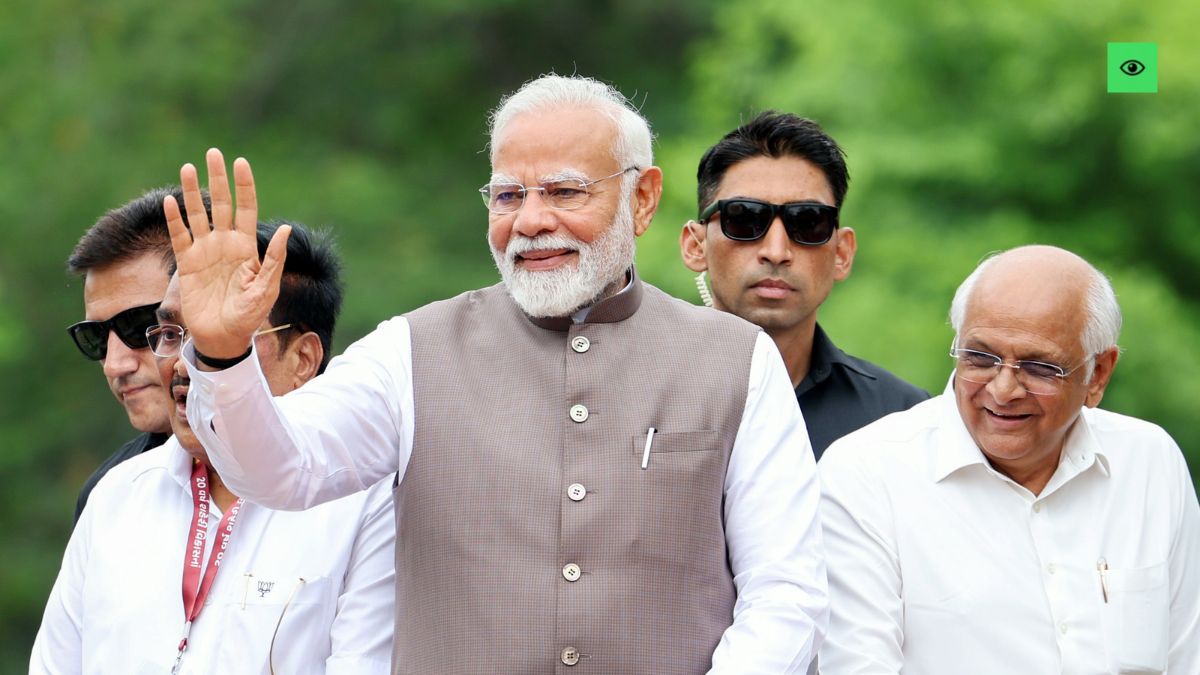
Prime Minister Narendra Modi held a roadshow in Banaskantha on Friday, October 30, during his two-day Gujarat visit. The programme includes the inauguration, dedication and foundation stone laying of development projects worth more than Rs 14,000 crore in the district.
The announcements cover infrastructure, transportation, animal husbandry, agricultural storage, child welfare and tourism. The scale of the programme makes Banaskantha a central focus of the visit, with several initiatives extending their benefits beyond the district.
One of the key highlights is the Bharat Bovine Breeding and Research Centre (BBBRC) at Bhildi. Spread across 127 acres, the facility has been established as a Centre of Excellence to strengthen bovine breeding, genetic improvement and advanced reproductive technologies.
It will be India’s first facility of its kind dedicated to the Kankrej cattle breed. The centre is expected to accelerate breed improvement by 10 to 20 times, bringing scientific breeding infrastructure into a sector that remains important to Gujarat’s rural economy.
DAIRY SECTOR GETS A TECHNOLOGY AND ENERGY BOOST
The dairy sector receives another significant push through two proposed Bio-CNG plants of Banas Dairy at Tharad and Radhanpur.
The Tharad plant will process 75 metric tonnes of cattle dung daily, while the Radhanpur facility will have a processing capacity of 100 metric tonnes per day.
These projects connect dairy activity with waste processing and renewable energy production. They also underline the growing importance of creating additional value from agricultural and livestock resources.
The Prime Minister will also dedicate 521 completed projects under the Agriculture Infrastructure Fund, involving a combined project cost of approximately Rs 4,950 crore.
The projects include cold storage facilities, cold chains, warehouses, silos, polyhouses, greenhouses and integrated processing infrastructure. Such facilities are essential for improving agricultural storage, processing and supply chain capacity.
The expansion of the potato processing plant at Sanadar and the commissioning of an Automated Storage and Retrieval System for ultra-high-temperature products at Palanpur are additional highlights.
AHMEDABAD METRO AND ROAD CONNECTIVITY TAKE CENTRE STAGE
Urban transportation and regional connectivity form another major part of the PM Modi Gujarat visit.
The Prime Minister will lay the foundation stone for Ahmedabad Metro Phase-2A, covering the Airport Extension, and Phase-2B, covering the GIFT City Extension.
Phase-2A will stretch over six kilometres, with five stations connecting Koteshwar Road to the airport. Phase-2B will cover more than 3.3 kilometres, with three stations connecting GIFT City to Shahpur.
The proposed extensions are intended to improve connectivity to two important destinations: Ahmedabad’s airport and Gujarat International Finance Tec-City.
Another major infrastructure project involves upgrading Ahmedabad-Mehsana Road, also known as State Highway-41, from four lanes to eight lanes.
Estimated to cost around Rs 2,600 crore, the project is expected to strengthen connectivity between Ahmedabad and North Gujarat.
The visit also includes two railway initiatives. Modi will flag off the Ahmedabad (Sabarmati)-Varanasi Express and the Mehsana-Becharaji-Sabarmati MEMU service, adding to the region’s rail connectivity options.
CHILD WELFARE AND FARMER SUPPORT ON THE AGENDA
Beyond major infrastructure, the programme includes investments in grassroots public services.
The Prime Minister will lay the foundation stone for 4,030 new child-friendly Anganwadi Centres and inaugurate 361 completed centres across Gujarat.
The initiative involves an investment of Rs 800 crore and is expected to benefit more than four lakh people.
For farmers, the announcement of the 24th instalment of PM-KISAN is another important component. The Prime Minister is scheduled to release approximately Rs 19,000 crore under the scheme, providing financial assistance to eligible farmers across the country.
He will also mark the commencement of on-ground activities under 12 approved horticulture clusters.
Spread across approximately 1.46 lakh hectares, these clusters are expected to benefit more than 1.3 lakh farmers. Two clusters in North Gujarat will focus on potato production, a significant agricultural activity in the region.
The combination of farmer assistance, horticulture development and agricultural infrastructure places considerable emphasis on the rural economy.
STATUE OF UNITY AND BHARAT PARV 2026
The second day of the visit, October 31, will shift the focus to Ekta Nagar in Kevadia, where the Prime Minister will offer floral tributes at the Statue of Unity.
The occasion marks the 151st birth anniversary of Sardar Vallabhbhai Patel and will be observed through Rashtriya Ekta Diwas celebrations.
Modi will also inaugurate Bharat Parv 2026, a celebration of India’s cultural heritage and national unity. The festival will provide States and Union Territories with a platform to showcase their traditions, folk performances, regional cuisines, handicrafts and tourism attractions. It will continue until November 15.
Another attraction will be Ekta Prakash Parv, featuring large-scale illumination displays celebrating India’s unity, diversity and progress.
Among the highlights are a 530-metre illuminated Valley of Flowers Road, themed ‘From Ancient India to Modern India’, and a 180-metre Glow Tunnel showcasing ‘Unity in India’s Diversity’.
More than 1.5 crore LED lights have been used for these installations.
EKTA NAGAR TO GET PROJECTS WORTH OVER RS 400 CRORE
The Prime Minister will also inaugurate and dedicate development projects worth more than Rs 400 crore in Ekta Nagar.
These include a sewage and water treatment plant, facade lighting, the upgradation of Narmada Ghat, an IRCTC hotel and tourism facilities.
The foundation stones will also be laid for projects covering Gora-Bhandra Road development, an integrated zero-waste smart solid waste management system, Khalwani Eco Tourism Development and the integrated development of the Cactus and Butterfly Garden.
The two-day visit will conclude with the Rashtriya Ekta Diwas celebrations and the Ekta Parade.
The parade will feature Central Armed Police Forces, State Police Forces and Central Police Organisations, highlighting their discipline, professionalism and contribution to national security.
This year’s programme will also focus on the achievements of security forces in tackling Left-Wing Extremism and the transformation of previously affected areas towards peace, security and development.
From Banaskantha’s dairy economy to Ahmedabad’s transport network and Ekta Nagar’s tourism infrastructure, the PM Modi Gujarat visit brings together a broad range of development initiatives.
The real measure of these announcements, however, will lie in their implementation, operational performance and the benefits they deliver to citizens, farmers and businesses.
Gujarat’s development agenda cannot be measured simply by the number of foundation stones laid or the value attached to project announcements. The real test is execution.
The proposed investments cover sectors that matter: transportation, agriculture, dairy, child welfare, renewable energy and tourism. Each has a different economic role, but their impact depends on how efficiently they move from announcement to operation.
For North Gujarat, agricultural infrastructure and dairy technology deserve particular attention. Better storage, scientific breeding and processing capacity can strengthen the wider rural economy. Similarly, Ahmedabad’s metro extensions and highway expansion address the growing importance of regional connectivity There is one metric that should matter more than the headline figure: measurable public benefit.

Any Comments?