
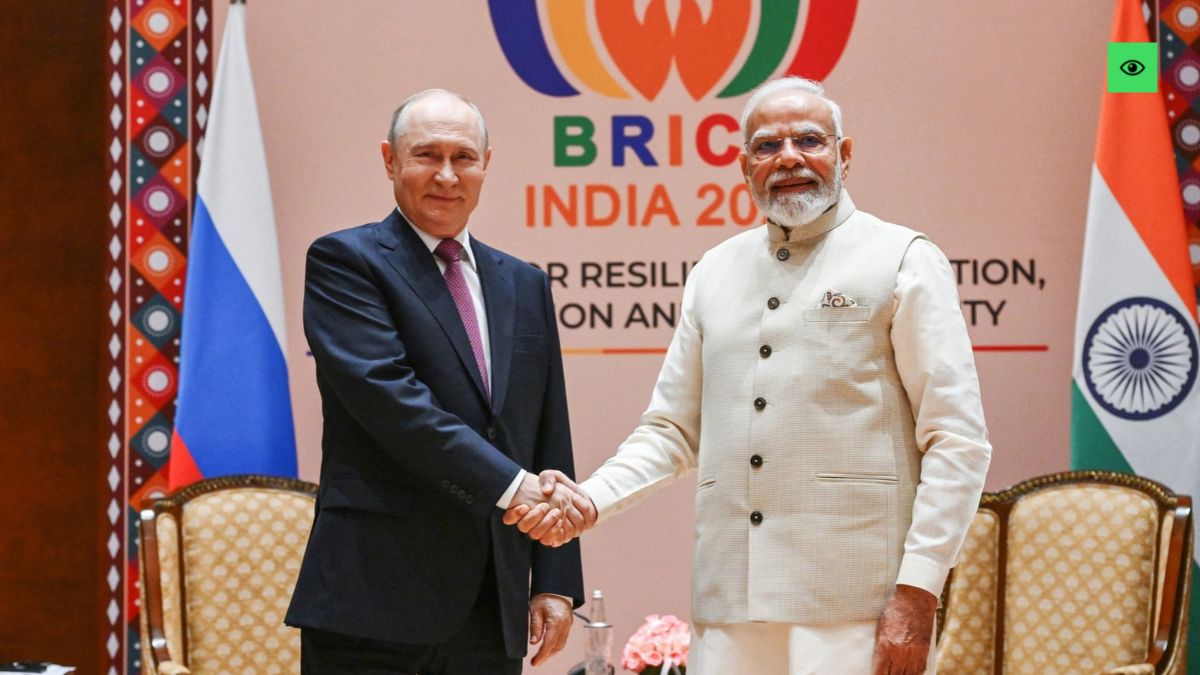
NEW DELHI, 24th Oct: India and Russia want to take bilateral trade to $100 billion by 2030. The target comes with another ambitious goal, $50 billion in two-way investment, alongside plans to strengthen industrial cooperation and address Russia’s demand for skilled workers.
The message from New Delhi and Moscow is clear. The relationship is looking beyond traditional diplomatic engagement and towards trade, investment, manufacturing and workforce development.
A statement by Indian Ambassador to Russia Vinay Kumar, in an interview with Russian news agency TASS published on October 24, 2026, outlined the direction of the partnership and the priorities discussed by Prime Minister Narendra Modi and Russian President Vladimir Putin.
India and Russia Bilateral Trade Targets $100 Billion by 2030
India and Russia are working towards a bilateral trade target of $100 billion by 2030. Alongside trade, the two countries are pursuing a two-way investment target of $50 billion over the same period.
According to Ambassador Vinay Kumar, Modi and Putin discussed the full range of bilateral relations on the sidelines of the BRICS summit held in New Delhi on September 12 and 13.
The leaders directed their respective ministries and agencies to further develop cooperation, particularly in trade and commerce.
That instruction matters because ambitious targets need more than political declarations. Governments must translate them into commercial opportunities, institutional partnerships and practical arrangements that businesses can use.
The announcement establishes the scale of the ambition. However, reaching the targets will depend on how effectively both countries develop their economic relationship over the coming years.
BRICS Summit Opens New Avenues for Industrial Cooperation
The BRICS summit provided a platform for India and Russia to discuss bilateral relations and strengthen their engagement.
Kumar highlighted the joint participation of Modi and Putin in the BRICS business summit as one of the concrete outcomes of their cooperation.
The leaders also visited Innoprom-India, described by the Indian ambassador as the first Russian industrial exhibition held in New Delhi.
Industrial exhibitions provide a meeting point for companies, policymakers and other stakeholders to explore commercial possibilities. They can help businesses understand each other’s markets, identify potential partners and examine opportunities for cooperation.
For India and Russia, industrial engagement could support the broader effort to expand trade and investment.
The significance of these activities lies in their connection to the larger economic agenda. Diplomatic meetings can establish priorities, but businesses and institutions must turn those priorities into working relationships.
The leaders’ direction to relevant ministries and agencies is intended to support that process.
India Russia Investment Target Reaches $50 Billion
Trade is only one part of the economic relationship. India and Russia are also aiming to increase two-way investment to $50 billion by 2030.
Investment can create longer-term commercial connections than individual transactions. Depending on the projects developed, it can support industrial capacity, technology exchange, business partnerships and employment.
The target also indicates that both countries want to deepen their economic engagement rather than focus exclusively on the exchange of goods and services.
However, the investment ambition should be understood as a target, not an achieved result. The ambassador’s comments describe the direction of bilateral cooperation and the work still required to reach the stated goals.
Progress will depend on whether companies find viable opportunities and whether the relevant institutions can facilitate cooperation.
For India, the opportunity is to strengthen its commercial engagement with Russia while developing productive capacity and expanding opportunities for Indian businesses. For Russia, closer engagement could support access to Indian industrial capabilities and a large pool of skilled personnel.
India Offers Russia a Skilled Workforce
One of the notable areas of cooperation is labour mobility.
Ambassador Kumar said India aims to supply Russia with the required number of skilled workers according to its needs. He added that Indians account for around 25 to 30 per cent of Russia’s quota for foreign workers.
The figure highlights India’s existing role in Russia’s foreign workforce arrangements, although the ambassador’s statement does not specify the total quota or the number of Indian workers involved.
Kumar also pointed to India’s demographic profile as a potential advantage.
With a population of nearly 1.5 billion, India has a substantial workforce. The average age of its workforce is 29, while workers account for approximately 69 per cent of the population, according to the ambassador.
These figures underline the scale of India’s human resources. But population size alone does not guarantee an effective workforce partnership.
The practical requirement is to match skills with demand. Russian industries need workers with relevant training, while Indian workers need suitable employment opportunities and the preparation required for their roles.
That is where education and institutional cooperation become important.
India Proposes Training Partnerships for Russian Industries
India trains specialists for both its domestic market and overseas employment, Kumar said.
He added that New Delhi had proposed that Russia establish educational institutions in India or collaborate with existing Indian institutions to train workers required by Russian industries.
The proposal could create a more structured approach to workforce development.
Rather than relying only on the availability of workers who already possess the required qualifications, educational partnerships could help align training with specific industrial needs.
For Russian companies, this could offer a route to developing a pipeline of suitably trained personnel. For Indian institutions, cooperation could provide opportunities to build specialised training programmes linked to international employment requirements.
For Indian workers, such arrangements could create clearer pathways to overseas jobs, provided the programmes are supported by appropriate qualifications, employment arrangements and worker protections.
The proposal remains a proposal at this stage. Kumar’s comments do not establish that Russian educational institutions have already been set up in India or that specific joint training programmes have been finalised.
Still, the idea connects workforce mobility with a broader economic objective: building cooperation around the capabilities each country can contribute.
What the India Russia Partnership Means for 2030
The economic agenda outlined by Kumar covers several connected priorities.
First, India and Russia want to increase bilateral trade to $100 billion. Second, they aim to expand two-way investment to $50 billion. Third, they are pursuing greater industrial cooperation. Fourth, they want to address Russia’s demand for skilled workers. Finally, India has proposed educational partnerships to train personnel for Russian industries.
These priorities are linked, but each requires practical follow-through.
Trade growth depends on commercial activity. Investment requires viable projects and business participation. Industrial cooperation needs partnerships that produce tangible outcomes. Workforce mobility requires suitable skills and arrangements that connect workers with employers.
The direction set by Modi and Putin provides a framework for pursuing these goals. The next challenge is implementation.
For India, the partnership presents an opportunity to use its manufacturing capabilities, educational institutions and workforce to expand international economic engagement.
For Russia, cooperation with India offers a route to deepen commercial links and explore workforce development arrangements suited to industrial demand.
Neither side can reach the stated targets through announcements alone. The results will depend on the projects, partnerships and employment arrangements developed between now and 2030.
The numbers are ambitious. The real measure will be how much commercial activity and practical cooperation they generate.
India and Russia have put forward ambitious economic targets, but the real test will be execution. A $100 billion trade objective and $50 billion in two-way investment offer a clear direction, yet neither figure represents a completed achievement. Both countries need commercial partnerships and practical arrangements that move the relationship beyond high-level meetings.
The skilled workforce proposal deserves particular attention. India has a large pool of workers, while Russia has specific industrial requirements. Connecting the two through appropriate training and educational partnerships could make cooperation more structured. However, the process must focus on relevant skills, credible employment opportunities and worker protections.
The priority should be measurable progress. Trade, investment, industrial cooperation and workforce development need practical implementation, not just ambitious declarations. By 2030, the value of this partnership will be judged by the outcomes both countries deliver.

Any Comments?