
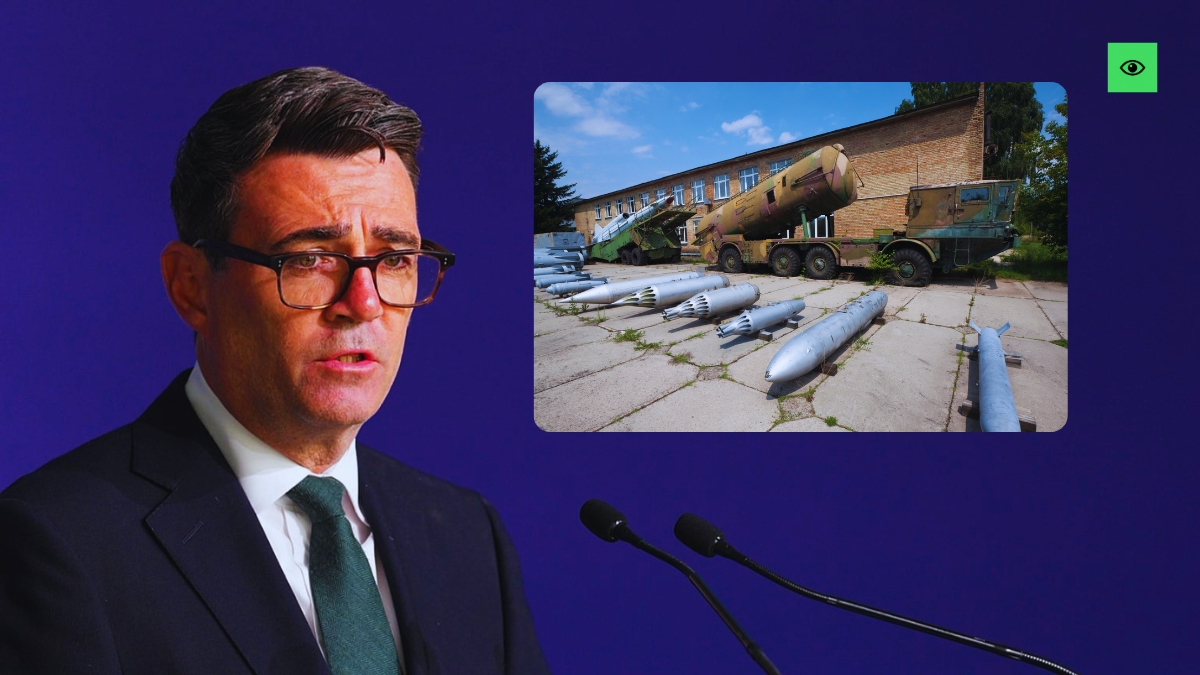
New Delhi, 24.08.26: Andy Burnham has arrived in Kyiv for his first overseas trip as British prime minister, choosing Ukraine’s Independence Day to deliver a blunt message: Britain’s support will not waver. The visit also comes with a major defence announcement involving long-range SCALP missiles.
Andy Burnham Ukraine Visit Comes With A Clear Message

British Prime Minister Andy Burnham arrived in Kyiv on Monday, August 24, for his first international visit since taking office. The timing is deliberate. Ukraine is marking the 35th anniversary of its independence, while Russia’s war continues to dominate Europe’s security agenda.
Burnham is expected to meet Ukrainian President Volodymyr Zelenskyy and co-chair his first meeting of the Coalition of the Willing alongside French President Emmanuel Macron and German Chancellor Friedrich Merz.
The British government has framed the visit as a direct demonstration of continued support for Ukraine. Burnham has said Ukrainians should have no doubt that Britain stands with them today and for as long as necessary.
The message is hardly subtle. London wants Kyiv to know that a change of government in Britain has not meant a change in its position on Ukraine.
Burnham Says Britain Will Stand With Ukraine
Burnham has repeatedly stressed that British support for Ukraine is not temporary or conditional.
Speaking ahead of the visit, he said Britain was fully behind Ukraine in its defence against Russia’s invasion. He also linked Ukraine’s security directly to Britain’s own security.
His position follows a similar assurance delivered last week after Moscow accused London of deliberately escalating the conflict.
The Russian embassy in Britain had warned that deeper UK involvement would bring consequences and accused London of trying to contain Russia through support for Ukraine.
Burnham’s response was straightforward. Britain, he said, was doing what it had consistently promised to do: support Ukraine’s ability to defend itself.
He also stressed that the UK would not be a fair-weather ally.
That matters because the dispute between Moscow and London has become increasingly sharp. Russia has objected to British military and technological support for Ukraine, while Britain continues to argue that Ukraine has the right to defend itself against Russia’s invasion.
SCALP Missile Technology Becomes A Major Part Of The Visit
The most consequential element of Burnham’s Kyiv trip may sit beyond the ceremonial speeches.
The British government has agreed to allow defence company MBDA to release classified information concerning UK components used in the SCALP long-range missile.
SCALP is the French-produced version of the UK’s Storm Shadow. The two systems use shared French and British technology.
The move is intended to support plans by Ukraine and France to establish local assembly lines for SCALP missiles in Ukraine.
In practical terms, Britain is helping create the conditions for Ukraine to increase its own long-range missile production rather than relying entirely on weapons supplied from abroad.
The decision builds on Britain’s previous support for Ukraine’s long-range strike capabilities and its broader effort to develop advanced, lower-cost long-range weapons for Kyiv.
For Ukraine, local production could become an important part of its longer-term defence strategy. For Britain, it represents another step in a policy that increasingly focuses not only on supplying weapons but also on strengthening Ukraine’s ability to produce them.
The Coalition Of The Willing Meets In Kyiv
Burnham’s visit also puts Britain at the centre of a wider European effort to coordinate support for Ukraine.
The Coalition of the Willing is expected to meet in Kyiv on Monday, with Burnham, Macron and Merz among those co-chairing the discussions. Ukrainian President Zelenskyy is also participating.
The group has been working on continued military and political backing for Ukraine, as well as longer-term security arrangements.
The August 24 meeting carries added symbolism because it falls on Ukraine’s Independence Day.
European governments are attempting to demonstrate that support for Kyiv remains intact even as the war continues and pressure grows for a durable settlement.
The British government has said its leadership role in the coalition will remain steady under Burnham’s administration.
A First Foreign Trip With Plenty Of Political Weight
Burnham’s decision to make Kyiv his first overseas destination as prime minister is significant.
His predecessor, Keir Starmer, helped establish the Coalition of the Willing with France and played a prominent role in European efforts to support Ukraine. Burnham is now taking up that role directly.
Just weeks after entering Downing Street, Burnham welcomed Zelenskyy to Britain. He has now travelled to Ukraine himself.
The sequence leaves little room for ambiguity about where his government stands.
The UK government says Britain has committed £25 billion in funding for Ukraine, including £16 billion in military assistance and £5.6 billion in non-military support. It has also highlighted the UK-Ukraine 100 Year Partnership as a framework for longer-term cooperation.
For Burnham, therefore, Kyiv is not simply a diplomatic stop. It is an early test of whether he can maintain Britain’s role in European security while managing a foreign policy inherited from the previous government.
Russia Watches Britain’s Kyiv Move
Moscow is unlikely to interpret the visit as a routine diplomatic gesture.
Russia has already criticised Britain’s involvement in Ukraine, particularly after reports that Ukrainian forces used drones manufactured by British companies.
The Russian embassy in London accused Britain of deliberately escalating the conflict and warned that increased involvement would carry consequences.
Relations have also been affected by a diplomatic gap in London. Russia’s ambassador, Andrei Kelin, recently left his post, and Moscow has yet to nominate a replacement. A charge d’affaires is currently leading the embassy, according to reports cited by British media.
That does not automatically establish a formal downgrade in diplomatic relations. It does, however, add another layer to an already strained relationship between Moscow and London.
Britain’s Position Is Getting Harder, Not Softer
Burnham’s Kyiv visit makes one thing clear: Britain is not signalling a retreat from its Ukraine policy.
Instead, the government is reinforcing military cooperation, supporting long-range weapons production and maintaining its leadership role in the Coalition of the Willing.
The missile technology decision is particularly important because it shifts part of the conversation from immediate weapons deliveries to Ukraine’s longer-term industrial capacity.
That is a different proposition from simply sending another shipment of equipment.
The political message is equally direct. Burnham wants Britain to remain a dependable partner for Ukraine, regardless of Russian threats or pressure.
He has also framed the relationship around what comes after the war, saying Britain will stand with Ukraine during both the conflict and reconstruction.
For Kyiv, the symbolism of a British prime minister arriving on Independence Day is obvious. For Moscow, the message is just as clear.
Britain intends to remain involved.
And Burnham appears determined to make sure nobody has to guess where he stands.
Britain has made its position clear, and Burnham is not trying to blur the edges.
The useful question now is not whether Britain supports Ukraine. It plainly does. The more important question is whether that support can be converted into durable capability.
Helping Ukraine build long-range missile capacity is a more strategic approach than treating every battlefield requirement as a fresh emergency. Local production, shared technology and industrial cooperation give the relationship a longer horizon.
That is where Britain should focus.
At the same time, London needs to keep its messaging disciplined. Strong rhetoric has its place, especially when Moscow is issuing threats. But policy should remain anchored in a clear objective: supporting Ukraine’s ability to defend itself while working with allies towards a just and lasting peace.
Burnham’s Kyiv visit is therefore more than symbolism. It is an early statement of intent.
Now comes the harder part: turning that intent into sustained policy, credible defence cooperation and practical results. @shivendraedits
India MUST not support such escalations.

Any Comments?