
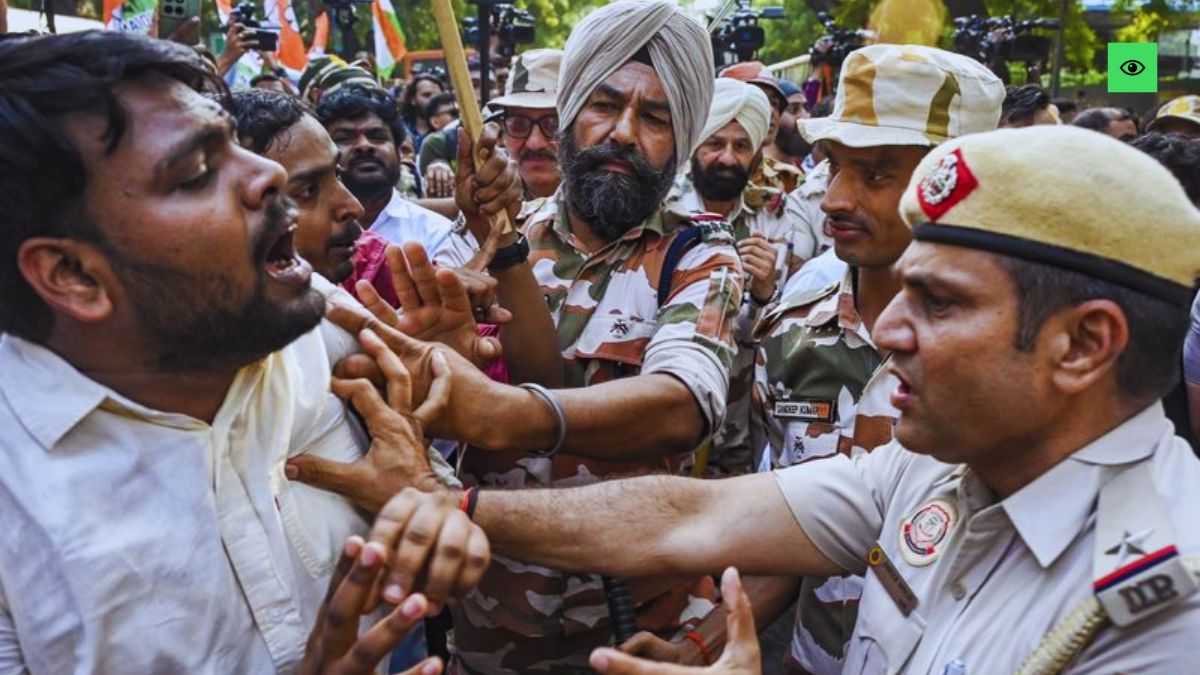
NEW DELHI, 15th Oct: Delhi security arrangements have come under scrutiny amid protests demanding Chief Election Commissioner Gyanesh Kumar’s resignation. Cockroach Janata Party founder Abhijeet Dipke has compared the capital’s security deployment to the India-Pakistan border, raising questions about policing, protest restrictions and the role of central forces.
The controversy now centres on a basic question: how should authorities balance public order with the right to protest?

Delhi Security Deployment: What Triggered the Controversy?
The dispute intensified as the Cockroach Janata Party (CJP), alongside student organisations, political groups and other activists, continued demonstrations demanding Kumar’s resignation over alleged irregularities in the Special Intensive Revision (SIR) exercise.
The allegations remain contested. However, the protests have triggered extensive security preparations across the capital, with police anticipating potential crowd-control and traffic challenges.
At a joint press conference in New Delhi, CJP founder Abhijeet Dipke criticised the government’s security arrangements. He argued that the scale of deployment and restrictions had made Delhi resemble a heavily guarded border rather than a national capital.
Dipke also accused the authorities of using force against students and Opposition leaders. His remarks reflected the growing confrontation between protest organisers and the police over the handling of demonstrations.
The immediate issue is not simply the number of personnel deployed. It is also whether the restrictions imposed on public spaces and movement are proportionate to the situation authorities expect to manage.
- Dipke Compares Delhi to the India-Pakistan Border
Dipke’s sharpest criticism concerned the extensive security presence in Delhi.
He accused the government of effectively turning the capital into a border-like zone to prevent demonstrations demanding Kumar’s resignation.
At the press conference, Dipke alleged that student organisations, Opposition members and former chief ministers had been dragged through the streets.
He also criticised police action against CJP members who were carrying the national flag and raising slogans against the Chief Election Commissioner.
These are allegations made by Dipke, not independently established findings in the reported account. Still, they underline the central dispute surrounding the protests: whether the police response has been proportionate to the anticipated public-order risks.
For authorities, preventing disorder and managing large gatherings are legitimate operational concerns. For protest organisers, restrictions and detentions raise questions about how freely demonstrators can express their demands.
The difference between those two positions is driving the controversy.
- Why Is Gyanesh Kumar Receiving So Much Protection?
Dipke also questioned the scale of security provided to Chief Election Commissioner Gyanesh Kumar.
He asked why Prime Minister Narendra Modi’s government was providing Kumar with extensive protection and suggested that the arrangement raised concerns about the relationship between the government and the election official.
Dipke further questioned whether Kumar was helping Modi win elections. These remarks represent Dipke’s allegations and suspicions, not established evidence of electoral misconduct.
The broader political dispute stems from allegations of irregularities in the SIR exercise, which protest organisers have cited in their demand for Kumar’s resignation.
The distinction matters. A political allegation can prompt public scrutiny, but it does not establish wrongdoing on its own. Any claim of electoral irregularity requires evidence and examination through the appropriate processes.
The controversy therefore has two connected but separate dimensions: the allegations against the election official and the security measures adopted in response to the demonstrations.
Conflating the two would obscure the questions that need answers.
- Delhi Police Seeks Extension for 273 CAPF Companies
One of the clearest indicators of the scale of the security preparations is Delhi Police’s request to extend the deployment of central forces.
According to a report by The Indian Express cited in the source article, the office of the Special Commissioner of Police (Operations) sent a request to the Union Home Ministry seeking an extension until October 20.
The request covered 273 companies of the Central Armed Police Forces (CAPF), extending their deployment beyond October 12.
The police cited intelligence inputs suggesting that further protests could take place and said additional personnel were needed to respond to a possible law-and-order situation.
The ministry had sanctioned 301 companies for Delhi Police: 221 on October 6 and another 80 on October 8. Each company comprises approximately 100 personnel.
However, according to the police communication, 28 of those companies had not reported for deployment.
The request therefore concerned extending the deployment of 273 companies rather than all 301 sanctioned companies.
These figures provide a concrete picture of the preparations. They do not, by themselves, establish whether the deployment was excessive or necessary. That assessment depends on the circumstances, intelligence inputs, operational requirements and the restrictions imposed on the public.
- Restrictions, Detentions and the Tricolour Gathering
The dispute also involves access to public spaces and the handling of demonstrations.
Dipke called on people to gather at Central Park on Friday with the national flag. He alleged that two CJP leaders, Ashutosh Ranka and Sourav Das, had been jailed merely for unfurling the Tricolour.
According to the source account, the two leaders had held the national flag and raised slogans against Kumar before police took them away on Tuesday.
Jantar Mantar had been denotified as a protest site on Monday, adding another complication for groups seeking to organise demonstrations.
The CJP and several other organisations and political parties have continued to demand Kumar’s resignation over the alleged irregularities in the SIR exercise.
The latest gathering call around Connaught Place also prompted preparations for possible crowd-control and traffic issues.
Dipke accused the authorities of bringing Delhi to a standstill through restrictions affecting railway and Metro services, along with the deployment of additional security forces.
The account does not independently establish the full extent of any service restrictions or their impact across the city. Those details matter because broad claims about disruption need to be distinguished from specific, documented restrictions.
- The Bigger Question: Public Order Versus the Right to Protest
The Delhi security deployment controversy raises a practical question for the administration: how can police prepare for potentially large demonstrations without imposing unnecessary restrictions on ordinary residents?
Large gatherings can create genuine challenges involving traffic, crowd movement and public safety. Police may need additional personnel when intelligence inputs indicate a risk of disorder.
But deployment figures alone cannot settle the debate. The public also needs clarity about the reasons for restrictions, the duration of security measures and the circumstances surrounding detentions.
For protest organisers, the ability to assemble and express political demands remains central to their challenge against the authorities. For the police, maintaining order and responding to potential threats are key responsibilities.
A credible assessment requires more than competing accusations.
It requires a clear account of the security rationale, the legal basis for restrictions and the specific actions taken during demonstrations.
The same standard should apply to the allegations against the Chief Election Commissioner. Claims of irregularities must be assessed on evidence rather than political rhetoric, while the handling of peaceful demonstrations must be examined on its own merits.
That is how the dispute can move beyond slogans and accusations.
The immediate focus remains on the protests, the possible extension of central-force deployment and the authorities’ preparations for further gatherings.
Delhi Police sought to retain 273 CAPF companies until October 20, citing the possibility of additional demonstrations. The request followed the sanctioning of 301 companies, of which 28 had not reported for deployment, according to the police communication.
Meanwhile, the CJP and other groups continue to demand Kumar’s resignation over alleged irregularities in the SIR exercise.
Dipke’s criticism has added another layer to the confrontation by questioning both the scale of security arrangements and the protection provided to the Chief Election Commissioner.
The key issues remain unresolved in the reported account: the merits of the allegations against Kumar, the proportionality of the security response and the circumstances surrounding the detentions.
For residents, commuters and demonstrators, the practical consequences of these decisions matter as much as the political arguments behind them.
Delhi’s security deployment has become a focal point in the dispute over protests demanding Chief Election Commissioner Gyanesh Kumar’s resignation.
Abhijeet Dipke’s border comparison captures the intensity of the criticism directed at the authorities, while the request to retain 273 CAPF companies highlights the scale of the police preparations.
Neither the deployment figures nor the allegations alone settle the underlying questions. The reasons for the security measures, the handling of protesters and the claims concerning the SIR exercise need to be assessed separately and on evidence.
In a democracy, public safety and peaceful protest are both important. The challenge is ensuring that security measures address genuine risks without creating avoidable barriers to lawful public expression.
Delhi’s security deployment controversy deserves scrutiny without jumping to conclusions. A request to retain 273 CAPF companies is significant, but the number alone does not prove that the deployment was either excessive or necessary. Authorities should explain the intelligence inputs, operational requirements and legal grounds supporting their decisions. Protest organisers, meanwhile, should ensure that allegations about election irregularities are backed by evidence and pursued through appropriate channels. The same standard must apply to claims of police excesses. Public order cannot become a blanket explanation for every restriction, just as political criticism cannot substitute for proof. The sensible approach is straightforward: disclose the rationale, examine specific incidents and distinguish verified facts from accusations. Security and democratic freedoms should not be treated as mutually exclusive.

Any Comments?