
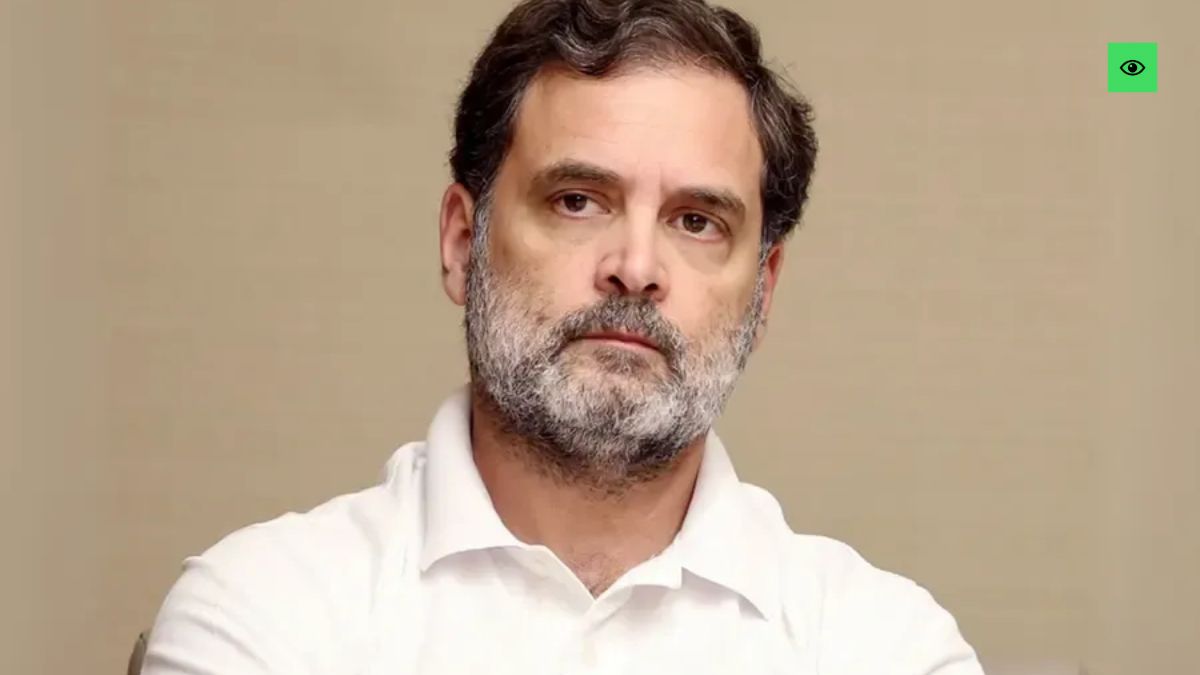
NEW DELHI, 6th Nov: A voter ID card is meant to establish a citizen’s identity as an elector, not determine whether someone deserves government assistance. Congress leader Rahul Gandhi has launched a sharp attack on the Modi government over a proposed voter ID-based identification requirement for welfare benefits, calling it a threat to citizens’ fundamental rights.
The controversy erupted after Union Panchayati Raj Minister Rajiv Ranjan Singh, popularly known as Lallan Singh, said beneficiaries would need an Elector’s Photo Identity Card (EPIC) number along with mandatory biometric authentication to access financial benefits and welfare payments under schemes administered by his ministry.
For Gandhi, this is much bigger than an administrative change. He sees a dangerous connection between voter lists, political representation and access to government assistance.
Voter ID and Welfare Benefits Trigger Political Storm
Rahul Gandhi criticised the Centre on Friday, accusing the Modi government of creating a system in which voter registration could become linked to access to public welfare programmes.
In a Hindi post on X, the Leader of Opposition in the Lok Sabha said the issue was not merely about alleged electoral manipulation but also about citizens potentially losing their rights.
“This isn’t just vote theft; it’s rights theft,” Gandhi said.
He also questioned the timing and implications of the proposed identification requirement, arguing that the government could make welfare access dependent on electoral records.
His central concern is straightforward: if someone’s name disappears from the voter list, could that person also face difficulties accessing government benefits?
Gandhi alleged that the government was preparing a system in which voter lists would influence who receives welfare assistance. He warned that people whose names are removed from electoral rolls could become vulnerable to losing access to important public services.
These are serious allegations, and they have intensified the political debate surrounding voter identification and welfare delivery.
Rahul Gandhi Links SIR With Alleged Vote Theft
Gandhi also connected the controversy with the Special Intensive Revision (SIR) of electoral rolls.
He alleged that millions of names were being removed from voter lists under the exercise and claimed that people opposing the BJP were particularly vulnerable.
According to Gandhi, the alleged deletion of names could have consequences extending beyond elections.
He questioned the independence of the Election Commission and targeted Chief Election Commissioner Gyanesh Kumar, accusing him of acting in collusion with the BJP.
Gandhi claimed that the preparation of electoral rolls was becoming a political issue and alleged that the process could create an electoral advantage for the ruling party.
He further argued that if the same electoral records were used to determine eligibility for welfare programmes, the consequences could become even more serious.
However, these remain political allegations made by the Congress leader.
Could Rations, Pensions and MGNREGA Be Next?
One of Gandhi’s strongest arguments focused on the possible expansion of voter ID-based identification beyond Panchayati Raj schemes.
He raised concerns about whether similar requirements could eventually affect access to:
- Ration benefits and food assistance.
- Government pensions.
- MGNREGA employment benefits.
- Housing assistance.
- Scholarships.
- Reservation-related benefits.
Gandhi questioned whether citizens could face difficulties accessing these programmes if their names were missing from electoral rolls.
His warning was particularly focused on economically weaker sections, who often depend on government assistance for essential financial support.
The broader question is important. Welfare schemes are designed to support eligible beneficiaries. Their accessibility should not become a source of uncertainty for people who depend on them.
At the same time, the minister’s reported remarks specifically concerned schemes under the Ministry of Panchayati Raj. Gandhi’s concerns about other welfare programmes represent a warning about possible future developments, not confirmation that the same requirement has been introduced across those schemes.
What Did Lallan Singh Say About EPIC and Biometric Authentication?
The controversy began with remarks by Union Minister Rajiv Ranjan Singh, also known as Lallan Singh.
He said that access to financial benefits and welfare payments under schemes of the Ministry of Panchayati Raj would require beneficiaries to provide their Elector’s Photo Identity Card number.
Mandatory biometric authentication would also form part of the identification process.
The announcement has raised questions about the relationship between electoral identity documents and welfare administration.
Aadhaar has been widely used as an identity mechanism in government service delivery. The minister’s remarks about using EPIC numbers instead have now triggered a political confrontation.
The distinction matters. Electoral identification and welfare eligibility are two separate issues. A voter ID establishes a person’s registration as an elector, while eligibility for a welfare scheme depends on the rules governing that particular programme.
The debate is now centred on whether linking these processes could create additional barriers for eligible beneficiaries.
Congress Calls It ‘Haq-Huqooq Chori’
The Congress had already attacked the Centre on Thursday following Lallan Singh’s remarks.
The party described the controversy as more than just vote theft, arguing that the alleged problem could extend to citizens’ rights and entitlements.
Its message was that ‘vote chori’ could be only the beginning, while ‘haq-huqooq chori’, or the alleged theft of people’s rights, could become the bigger issue.
Rahul Gandhi reinforced this position through his social media post and video clip of the minister’s remarks.
The Congress has framed the matter as a question of democratic accountability and welfare access rather than simply another political disagreement between the ruling party and opposition.
Why the Voter ID and Welfare Benefits Debate Matters
India runs numerous welfare programmes aimed at supporting vulnerable households, workers, farmers, pensioners and students.
For many beneficiaries, these payments are not optional conveniences. They help cover basic expenses.
That makes identification requirements an important policy issue.
The government needs reliable systems to identify beneficiaries, prevent duplication and ensure that assistance reaches eligible people. But identification mechanisms must also avoid excluding genuine beneficiaries.
This is where the controversy surrounding voter ID and welfare benefits becomes significant.
If EPIC numbers and biometric authentication become mandatory for accessing particular schemes, the implementation process will matter enormously. Questions about documentation, authentication failures and the treatment of eligible people who face verification difficulties deserve clear answers.
The political argument is loud. The administrative questions are equally important.
The Centre’s position on the precise implementation and safeguards will be crucial in determining how this requirement affects beneficiaries.
CONCLUSION
Rahul Gandhi has turned Lallan Singh’s voter ID remarks into a wider political confrontation over electoral integrity and welfare access.
His warning is that a person’s presence on the voter list should never determine whether that person receives government assistance.
The issue now goes beyond BJP versus Congress. It raises a fundamental policy question: should electoral identity and welfare entitlements be linked in a way that could affect eligible citizens?
For a country with millions dependent on public welfare programmes, clarity is essential. Citizens should not have to worry that losing their place on an electoral roll could also mean losing access to assistance they are entitled to receive.

Any Comments?