
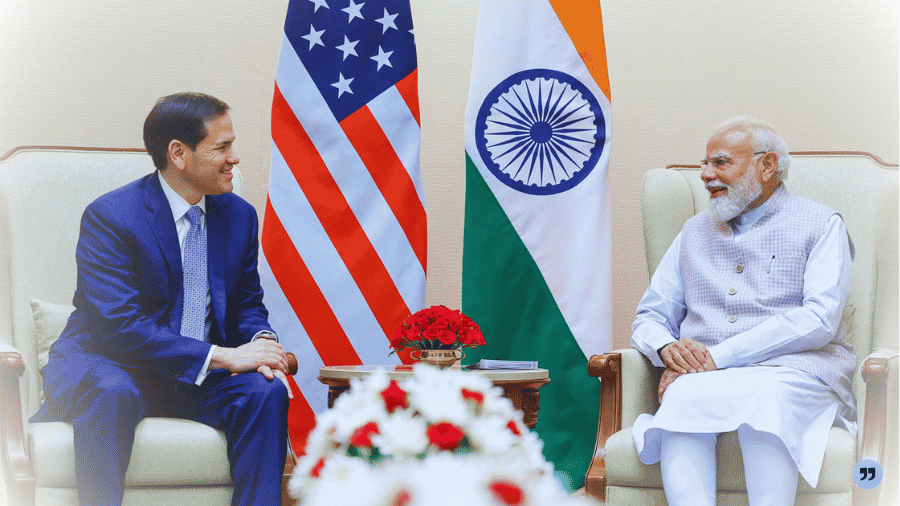
24/05/26: The United States has made its message crystal clear. Washington wants a deeper India US energy partnership, bigger trade numbers, tighter strategic alignment, and a stronger grip over energy flows rattled by the Iran crisis. And Marco Rubio did not arrive in New Delhi to whisper that message politely.
The US Secretary of State used his India visit to push American energy exports hard while framing India as a central player in Washington’s Indo-Pacific strategy. Somewhere between diplomacy and business expansion, the gloves quietly came off.
The timing matters. Oil markets are jittery. Supply chains are under stress. Iran remains the elephant stomping around the Strait of Hormuz. And India, one of the world’s largest crude importers, suddenly sits at the centre of a geopolitical chessboard where every barrel counts.
The smartest thing India is doing right now is refusing to become emotionally dependent on any one geopolitical camp. That matters.
For years, global powers treated India like a market to influence. Now they treat India like a strategic necessity. Huge difference.
America wants India buying more US energy. Russia wants India to continue purchasing discounted crude. Gulf nations want long-term energy ties. Europe wants supply chain cooperation. Everybody suddenly loves India’s “strategic importance.” Funny how that happens when your economy keeps growing while others wobble.
India should absolutely deepen the India US energy partnership. It makes economic and strategic sense. Diversification reduces risk. Stronger ties with Washington open doors in technology, defence, and advanced manufacturing.
But India must stay ruthlessly practical.
No country acts out of charity in geopolitics. Not America. Not Russia. Not China. Not anyone.
Energy security cannot depend on slogans or friendship optics. It depends on leverage, infrastructure, supply diversity, and negotiation strength. India’s best strategy is exactly what it appears to be doing right now: build relationships everywhere, stay flexible, avoid ideological traps, and extract maximum advantage from every global power competing for influence.
That is not fence-sitting.
That is smart statecraft.
Rubio Draws A Hard Line On Iran And Energy Markets
During talks with Prime Minister Narendra Modi, Rubio stressed that the United States would not allow Iran to “hold the global energy market hostage.” That line was not accidental. It was aimed at calming markets, warning Tehran, and nudging allies like India toward alternative supply arrangements.
Washington’s pitch is straightforward. Buy more American energy. Reduce exposure to unstable or sanctioned supply chains. Build long-term energy resilience through strategic partnerships.
Rubio openly said US energy products could help diversify India’s energy basket. Earlier, he had gone even further, saying America wants to sell India “as much energy as they’ll buy.”
That is not subtle diplomacy. That is a sales pitch wrapped in strategic doctrine.
And frankly, the US has reasons to push hard.
The Iran conflict has rattled shipping routes and added volatility across global oil markets. It has also complicated Washington’s long-running effort to reduce India’s reliance on discounted Russian crude. Every flare-up near the Strait of Hormuz sends traders into panic mode. Insurance costs jump. Freight calculations go wild. Energy diplomacy suddenly becomes survival math.
India understands this reality better than most countries.
Why India Matters In America’s Energy Strategy

India is not just another customer in the global oil market. It is the customer everybody wants.
The country’s rising industrial demand, expanding middle class, manufacturing ambitions, and infrastructure growth make it one of the biggest long-term energy markets on the planet. The Americans know it. The Russians know it. The Gulf knows it. Everybody wants a larger piece of India’s future energy appetite.
Rubio’s visit reflected that urgency.
Beyond energy discussions, the US Secretary of State spoke about strengthening critical supply chains, expanding cooperation on emerging technologies, and deepening defence coordination. The broader framework remains Washington’s “Mission 500” trade push, which aims to double bilateral trade by 2030.
That target sounds ambitious. Then again, so did India becoming a global digital powerhouse fifteen years ago. Funny how that worked out.
Rubio also invited Prime Minister Modi to visit the White House on behalf of President Donald Trump, signalling that Washington wants political momentum behind the expanding partnership.
In public statements after the meeting, Rubio described India as a “great ally” and “great partner” while praising cooperation through the Quad grouping involving India, the US, Australia, and Japan.
The Quad Is Quietly Becoming More Than A Security Club
Officially, the Quad focuses on maintaining a free and open Indo-Pacific. Unofficially? It is increasingly evolving into a platform for supply chain coordination, strategic technology collaboration, maritime security, and economic balancing against China’s growing influence.
Energy security now sits firmly inside that conversation.
Rubio’s upcoming participation in the Quad Foreign Ministers’ Meeting in New Delhi underlines how central India has become to America’s Asia strategy.
This is not Cold War politics recycled with prettier logos. This is modern power competition built around semiconductors, shipping lanes, rare earths, AI systems, clean energy, and oil routes.
And India sits right in the middle of all of it.
Modi Pushes Jobs And Growth Through Rozgar Mela
While Rubio’s visit dominated diplomatic headlines, Prime Minister Narendra Modi used the 19th edition of Rozgar Mela to hammer home a very different message. India’s growth story, he argued, belongs to its youth.
More than 51,000 appointment letters were distributed across government departments and organisations during the recruitment drive. According to official figures, nearly 12 lakh appointments have been issued through Rozgar Melas so far.
Addressing recruits through video conferencing, Modi said India’s youth are driving the country toward its Viksit Bharat 2047 vision.
He pointed to emerging sectors like green hydrogen, clean energy, sustainable manufacturing, and critical minerals as future engines of employment and economic expansion.
That matters in the context of the India US energy partnership too.
India is no longer discussing energy security merely as fuel procurement. The conversation has widened. Clean energy ecosystems, battery manufacturing, semiconductor supply chains, digital infrastructure, logistics corridors, and critical mineral access are all becoming interconnected.
The world is shifting from simple oil diplomacy to full-spectrum economic alliances.
India knows it cannot rely on one country, one route, or one supplier forever. Diversification is no longer optional. It is policy insurance.
Washington Wants More Than Energy Deals
Look carefully at Rubio’s remarks and a larger pattern emerges.
The US is trying to position itself not just as an energy supplier, but as India’s long-term strategic stabiliser in an increasingly unstable world.
That includes defence cooperation.
That includes emerging technologies.
That includes critical minerals.
That includes trade.
And yes, it definitely includes counterbalancing China’s influence across the Indo-Pacific.
The Biden-era caution around India’s Russian oil purchases appears to be evolving into something more pragmatic under Trump’s current administration. Washington still wants India to reduce dependency on Moscow, but it also understands reality. India will buy energy where it finds strategic and economic advantage.
So America’s new strategy appears simple. Compete harder. Offer alternatives. Stay indispensable.
Honestly, that is smarter than endless moral lectures.
India Holds More Leverage Than Ever Before
There is another amazing truth here.
India is no longer approaching global negotiations from a defensive position. Whether it is energy, technology, manufacturing, or geopolitics, New Delhi now negotiates with far greater leverage.
The West needs India’s market.
Global companies need India’s scale.
Strategic alliances need India’s geography.
And supply chains increasingly need India’s stability.
That changes the tone of every diplomatic conversation.
Rubio’s India visit reflected exactly that shift.
Washington is not engaging India as a secondary Asian partner anymore. It is engaging India as a central pillar in its future economic and geopolitical calculations.
Conclusion
Marco Rubio’s India visit was about far more than polite diplomatic handshakes and staged photo opportunities.
It was about oil routes, trade corridors, strategic influence, technology ecosystems, and the future architecture of global power.
The India US energy partnership now sits at the heart of that conversation.
As Iran tensions continue rattling global energy markets, America wants India closer. India, meanwhile, wants options, leverage, and strategic flexibility.
That balance will define the next phase of the relationship.
And if Washington truly believes India is the future, it will have to do more than sell oil. It will need to prove it can be a reliable long-term partner in a world that is becoming less predictable by the month.

Leave a Mark