
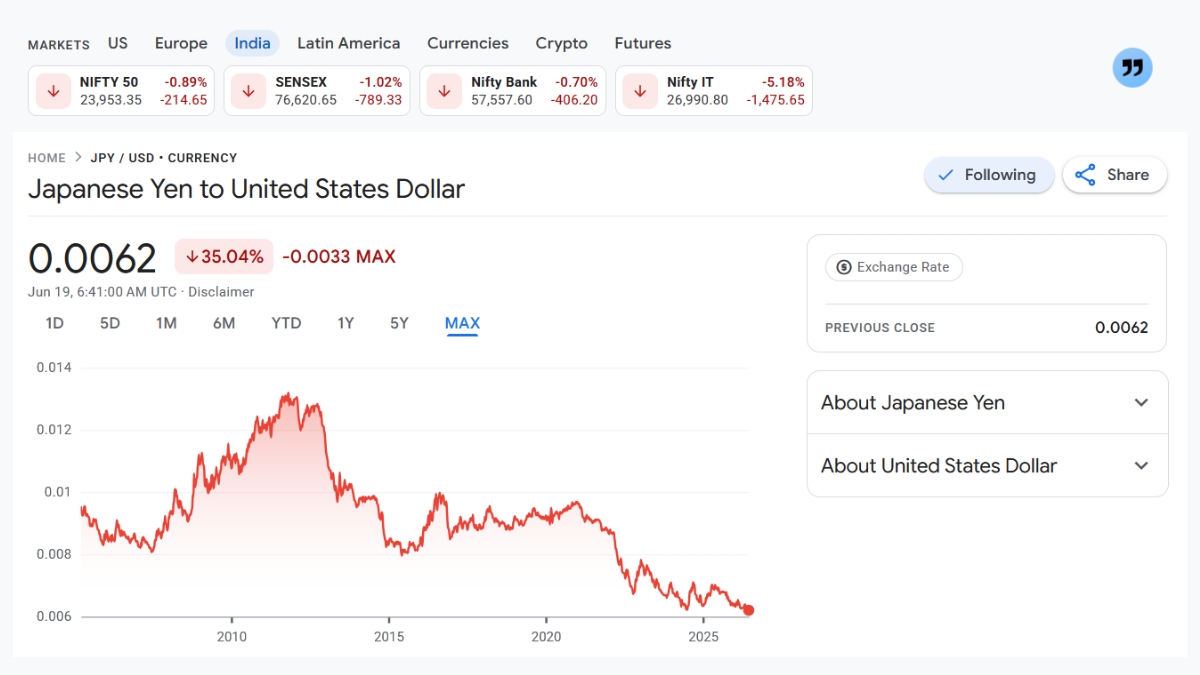
New Delhi, 19.06.26: The Japanese yen remained under intense pressure on Friday, trading close to its weakest level in decades despite recent efforts by Japanese policymakers to stabilize the currency.
The yen traded around 161.12 against the US dollar after briefly slipping as low as 161.81 during overseas trading, marking its weakest level since July 2024. The modest recovery did little to calm markets, with investors increasingly expecting Japanese authorities to step in if speculative selling intensifies.
Japan’s Ministry of Finance has reiterated that it stands ready to take decisive action should currency movements become excessive, keeping traders alert for another round of intervention.
Japan Draws a Line in the Sand

Finance Minister Satsuki Katayama said there has been no change in the government’s willingness to intervene if speculative moves threaten currency stability.
Her remarks came as the yen hovered in the upper 161 range against the dollar, close to levels widely viewed by market participants as politically and economically uncomfortable for Tokyo.
Earlier government data showed authorities spent a record ¥11.73 trillion, roughly $73 billion, on foreign exchange intervention between late April and late May. Those operations temporarily lifted the yen back toward the 155 level before renewed dollar strength erased much of the gains.
Market analyst Tony Sycamore of IG believes officials are likely to defend the 161.95 level initially with intervention similar in scale to previous operations. However, he cautioned that policymakers may eventually need to become more selective in deploying reserves to preserve both financial firepower and policy credibility.
BOJ Tightening Has Yet to Deliver
The Bank of Japan recently raised its benchmark interest rate by 25 basis points to 1.0%, its highest level since 1995 and the first increase since December.
Ordinarily, higher interest rates would support a country’s currency by making domestic assets more attractive. Yet the yen has continued to weaken.
Analysts point to the still-wide interest rate gap between Japan and the United States, along with persistent speculative selling, as the primary reasons behind the currency’s decline.
According to DBS analysts, speculative short positions against the yen remain elevated despite tighter monetary policy. They expect Japanese authorities to rely on increasingly forceful verbal warnings alongside direct market intervention if depreciation continues.
Questions surrounding Prime Minister Sanae Takaichi’s fiscal spending plans have also weighed on investor confidence, adding another layer of uncertainty for currency markets.
Inflation Remains Below Target
Japan’s latest inflation figures presented a mixed picture for policymakers.
Core consumer inflation, which excludes fresh food, remained at 1.4% year on year in May, marking the fourth consecutive month below the Bank of Japan’s 2% target. Government fuel subsidies helped offset the inflationary impact of higher commodity prices.
Inflation excluding both fresh food and energy eased to 1.8% from 1.9% in April, while headline inflation edged up slightly to 1.5%.
Although current inflation remains relatively subdued, economists expect price pressures to strengthen in the coming months.
Marcel Thieliant of Capital Economics said there are still few signs that higher energy costs are feeding into broader goods and services inflation. However, he believes that process is only delayed rather than avoided.
The firm forecasts inflation excluding fresh food and energy could accelerate to around 3.5% as rising energy costs gradually work their way through utility bills and consumer prices.
Energy Prices Continue to Shape Japan’s Outlook
Japan remains heavily dependent on imported energy, sourcing around 90% of its crude oil from the Middle East before the recent regional conflict.
The peace agreement between the United States and Iran has reduced immediate concerns over global energy supplies and allowed shipping activity through the Strait of Hormuz to begin normalizing.
However, a complete return to pre-conflict shipping levels is expected to take time.
Government fuel subsidies have helped cushion consumers from rising oil prices, but policymakers acknowledge that higher import costs continue to pose risks for inflation and economic growth.
The Bank of Japan has also warned that companies could eventually pass rising raw material costs on to consumers, creating stronger inflationary pressure over time.
Dollar Strength Dominates Global Markets
While the yen struggled, the US dollar remained firmly supported by shifting expectations for American monetary policy.
Federal Reserve Chair Kevin Warsh adopted a more hawkish tone following this week’s policy meeting, reinforcing expectations that further interest rate increases remain possible.
The dollar index traded near 100.82 after reaching a one-year high in the previous session.
According to CME FedWatch data, traders are now pricing a 38.5% probability of a 25-basis-point Federal Reserve rate hike at the July meeting, a sharp jump from just 8% one week earlier.
The stronger dollar kept pressure on most major currencies.
The euro held broadly steady near $1.1457, while the Australian dollar slipped to $0.7011. The New Zealand dollar remained close to $0.5752.
Global Central Banks Stay Cautious
Japan is not the only economy balancing inflation risks against slowing growth.
The European Central Bank recently raised interest rates as higher energy prices pushed inflation upward across the euro area.
The US Federal Reserve kept rates unchanged but signalled continued vigilance as inflation remains elevated.
Australia’s central bank also left interest rates unchanged this week after multiple increases earlier this year. The Bank of England maintained its policy stance, while Indonesia has tightened monetary policy several times in recent weeks.
The broader message from central banks remains consistent. Inflation risks have not disappeared, and policymakers are reluctant to declare victory too early.
Cryptocurrencies Slip
Digital assets also reflected the stronger dollar environment.
Bitcoin eased 0.2% to $62,897, while Ether declined 0.3% to $1,703 as investors continued adjusting portfolios for tighter global financial conditions and higher interest rate expectations.
Why the Weak Yen Matters
A weaker yen raises the cost of imported goods, particularly fuel and raw materials, increasing pressure on businesses and households across Japan.
Although exporters often benefit from a cheaper currency, prolonged weakness risks importing inflation into an economy that depends heavily on overseas energy supplies.
For global markets, the yen also serves as an important barometer of investor sentiment. Any large-scale intervention by Japan could trigger significant volatility across foreign exchange markets.
Why It Matters for India
For India, developments in the yen and global currency markets extend beyond Japan’s domestic economy.
A stronger US dollar often puts pressure on emerging market currencies, including the rupee, while fluctuations in global oil prices directly influence India’s import bill and inflation outlook.
Stable shipping through the Strait of Hormuz also remains crucial for India’s energy security, making geopolitical developments in the region closely watched by policymakers and businesses alike.
The Japanese yen has become more than a currency story. It is a test of how far monetary policy can go when global interest rate differentials continue pulling capital in the opposite direction. Japan has raised rates, intervened heavily and issued repeated warnings, yet the market keeps challenging policymakers. That suggests investors remain unconvinced that short-term action alone can reverse broader economic forces.
Leave a Mark