
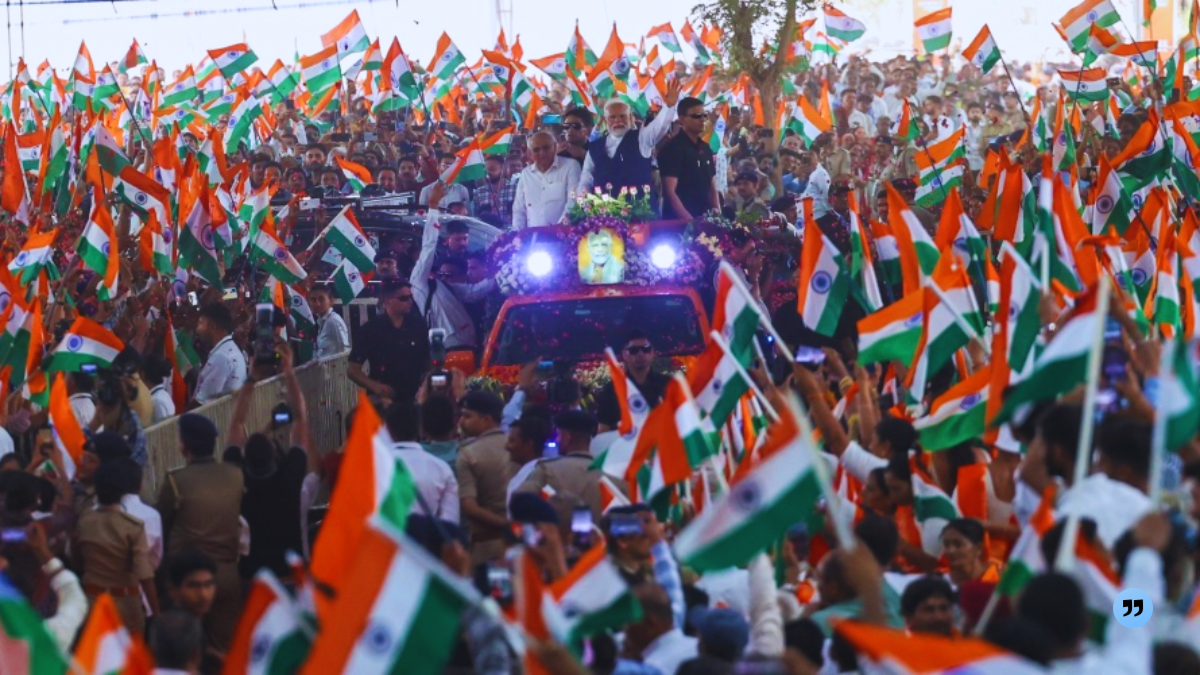
New Delhi, 10.06.26: Prime Minister Narendra Modi has officially become India’s longest-serving elected Prime Minister, surpassing Jawaharlal Nehru’s post-election tenure record after completing 4,399 consecutive days in office on June 10, 2026.
For supporters, it is a moment of historic validation. For critics, it is a reminder that longevity alone cannot define success. For India, it is an opportunity to assess one of the most consequential political and economic eras since independence.
A Record That Rewrites India’s Political History

When Narendra Modi took oath on May 26, 2014, India was emerging from a period of slowing growth, policy paralysis allegations and public frustration over corruption scandals.
Twelve years later, the political landscape looks entirely different.
Modi has won three consecutive national mandates, achieved a level of electoral dominance rarely witnessed in modern democracies and now stands alone as India’s longest-serving elected Prime Minister.
The milestone surpasses Jawaharlal Nehru’s record of 4,398 consecutive days served after India’s first general election.
Regardless of political preference, the achievement is historically significant.
Few democratic leaders anywhere in the world maintain public support long enough to dominate national politics for more than a decade.
World Leaders Recognise Modi’s Global Influence
Congratulatory messages arrived from several international leaders even before the record was officially crossed. [PIB Release]
Sri Lankan President Anura Kumara Disanayaka described the achievement as a reflection of the trust repeatedly placed in Modi by India’s voters. The message carried symbolic weight given India’s assistance to Sri Lanka during its economic crisis and the strengthening of bilateral relations in recent years.
Papua New Guinea Prime Minister James Marape called Modi a leadership role model and highlighted India’s efforts to reduce poverty while elevating the voice of developing nations.
Trinidad and Tobago Prime Minister Kamla Persad-Bissessar praised Modi’s journey from humble beginnings to leading the world’s largest democracy for three consecutive terms.
The reactions underscored a broader reality. India’s global influence today is considerably larger than it was in 2014.
Whether through G20 leadership, Global South diplomacy, strategic partnerships or economic engagement, India now occupies a far more central position in international affairs.
The Economic Story: From $2 Trillion to Over $4 Trillion
The most visible transformation of the Modi era is economic scale.
When Modi first entered office, India’s economy was valued at roughly $2 trillion.
Today, it exceeds $4 trillion.
India has emerged as one of the fastest-growing major economies in the world while navigating global disruptions including geopolitical conflicts, supply chain shocks and inflationary pressures.
Foreign exchange reserves remain among the strongest in India’s history, while public finances have increasingly prioritised infrastructure-led growth.
The government argues that roads, railways, logistics corridors and digital infrastructure create the foundation for long-term prosperity.
Judging by investment trends, many investors appear to agree.
Infrastructure Became the Centrepiece
Perhaps no area reflects Modi’s governance model more clearly than infrastructure.
Across India, highways have expanded rapidly. Airports have appeared in cities that once relied on distant connections. Railway modernisation accelerated through electrification, station upgrades and Vande Bharat services.
Massive capital expenditure became a defining economic strategy.
Supporters often argue that infrastructure is where ordinary citizens physically experience governance.
You don’t need statistics to notice a new expressway. You simply drive on it.
That visibility has become one of the government’s strongest political advantages.
The UPI Revolution Changed Everyday India
If highways transformed movement, UPI transformed money.
India’s Unified Payments Interface has become one of the world’s largest real-time digital payment systems.
From tea stalls and vegetable vendors to multinational retailers, digital transactions have become part of daily life.
Billions of transactions now flow through the system every month.
The platform has expanded internationally and become a case study in digital public infrastructure.
Few policy interventions over the past decade have altered everyday economic behaviour as dramatically.
Financial Inclusion and Welfare at Massive Scale
The Modi years also witnessed one of the largest welfare and financial inclusion expansions in modern history.
- Jan Dhan accounts brought millions into the banking system.
- Ayushman Bharat expanded healthcare coverage.
- Ujjwala increased LPG access among low-income households.
- Jal Jeevan Mission dramatically expanded rural tap-water connectivity.
- Rural housing construction accelerated under PMAY-Gramin.
Supporters argue these programmes have improved quality of life for millions while reducing leakages through technology-driven delivery systems.
Critics acknowledge expanded coverage but continue to debate implementation quality and long-term outcomes.
Defence and Manufacturing: Progress with Unfinished Business
Defence manufacturing has emerged as one of the success stories of the Modi era.
Defence exports have increased dramatically compared to 2014 levels, while India has expanded its ambitions as a defence manufacturing hub.
Electronics production has also accelerated.
India is now a major smartphone manufacturing centre, with global supply chains increasingly integrating Indian facilities.
Yet manufacturing remains the most important unfinished chapter.
The Make in India initiative originally envisioned manufacturing contributing 25 percent of GDP.
That target remains distant.
Successive governments have understood a simple reality. Countries become rich when they manufacture at scale.
India has made progress. But progress and completion are not the same thing.
Employment Remains the Most Important Question
Every government can point to projects.
Every government can point to statistics.
Employment is different.
Jobs ultimately determine how citizens experience economic growth.
Government data points to improvements in formalisation, labour participation and EPFO registrations.
Critics argue that quality employment opportunities have not expanded quickly enough for India’s young workforce.
This remains one of the most closely watched indicators for economists, investors and policymakers alike.
Film Industry and Political Leaders Join Celebrations
Several actors and political leaders congratulated Modi on reaching the milestone.
Mukesh Rishi praised the Prime Minister’s discipline, commitment and visible infrastructure achievements.
Vindu Dara Singh described the moment as historic and credited Modi for giving India direction and global recognition.
Veteran actor Raza Murad called it a monumental day in India’s democratic journey.
Union ministers including Arjun Ram Meghwal and Pralhad Joshi hailed the record as evidence of public trust and national progress.
Maharashtra Deputy Chief Minister Eknath Shinde described the achievement as a matter of pride for 140 crore Indians.
Congress Launches Counterattack
The Opposition Congress used the occasion to present a very different assessment.
Rahul Gandhi criticised what he described as anti-poor policies and questioned rising costs faced by ordinary households.
Congress released an extensive “promise versus reality” report covering issues ranging from employment and inflation to foreign policy and economic performance.
Party leaders argued that headline announcements have not always translated into broad-based improvements in people’s lives.
The government and its supporters strongly reject those claims.
Union Home Minister Amit Shah argued that the past twelve years have witnessed an unprecedented combination of welfare expansion and development.
Union Law Minister Arjun Ram Meghwal described Modi’s tenure as a period in which India’s prestige, economic strength and global standing have all expanded significantly.
The debate reflects a broader truth about Indian democracy.
The larger the achievement, the larger the argument surrounding it.
The Bottom Line
Narendra Modi’s record is now part of history.
The numbers are settled.
The debate is not.
India today is wealthier, more digitally connected, more infrastructure-intensive and more globally influential than it was in 2014.
At the same time, manufacturing expansion, employment generation and inclusive prosperity remain critical challenges for the years ahead.
That is why this milestone matters.
It is not merely about one politician surpassing another.
It is about evaluating twelve years that reshaped India’s political narrative, economic trajectory and global identity.
Supporters see transformation.
Critics see unfinished promises.
History will likely conclude that both stories contain elements of truth.
What cannot be disputed is this: on June 10, 2026, Narendra Modi became India’s longest-serving elected Prime Minister, closing one chapter of Indian political history while opening another.
Economic size matters. Economic quality matters more.
India’s greatest challenge is no longer proving it can grow. It is proving that growth can consistently generate high-quality jobs, stronger manufacturing output and rising living standards for hundreds of millions of people.
If that transition succeeds, Modi’s record will be remembered as the foundation of India’s emergence as a developed economic power.
If it falls short, history may remember this period as one of enormous potential that remained partially unrealised.
The record has been broken.
The verdict on the legacy is still being written. – ARM THE OPINION
Leave a Mark