
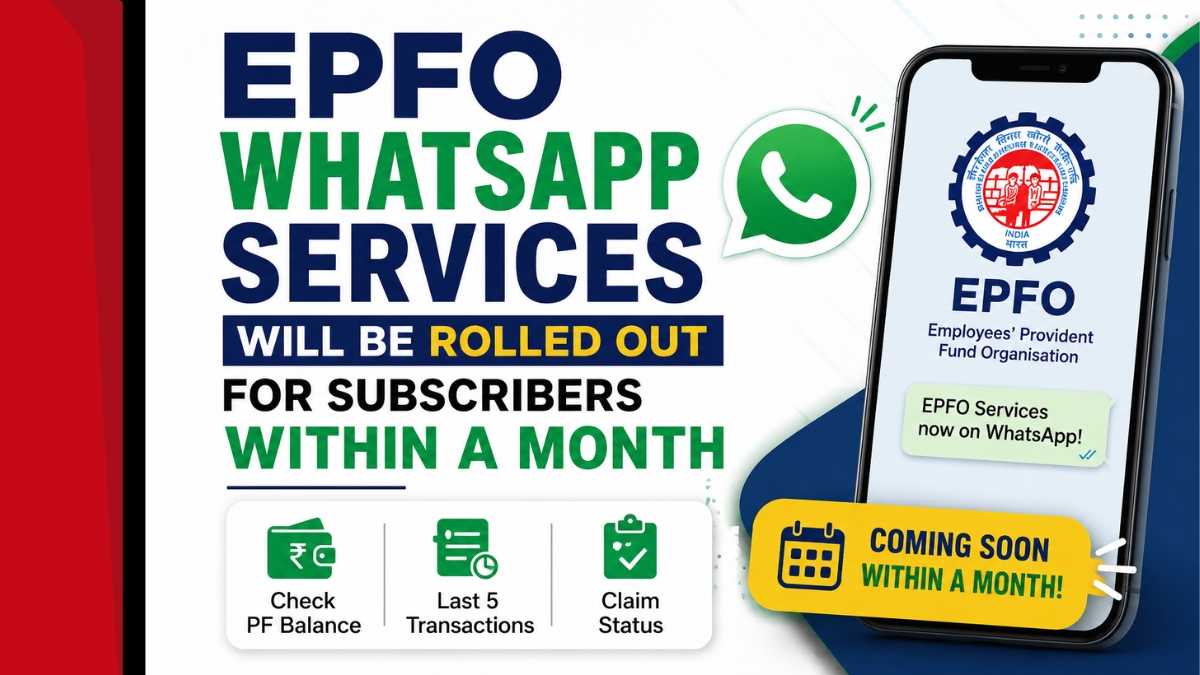
19/05/26: India’s EPFO is finally doing what millions of salaried workers have wanted for years. Soon, checking PF balance, claim status, and recent transactions may be as easy as sending a WhatsApp message. No portal drama. No endless logins. Just chat and get the details.
The Employees’ Provident Fund Organisation has announced that EPFO WhatsApp services will be rolled out for subscribers within a month. The move is part of a broader digital push by the Labour Ministry aimed at simplifying access to provident fund services for workers across India.
For an institution often associated with paperwork, delays and password resets from another dimension, this is a sharp pivot.
EPFO WhatsApp Services to Bring PF Details Directly to Users

Union Labour Minister Mansukh Mandaviya confirmed on Tuesday in New Delhi that EPFO subscribers will soon be able to use WhatsApp to access essential services. These include checking PF balance, viewing the last five transactions, and tracking claim status.
That alone could dramatically reduce dependency on the EPFO website and mobile portals, both of which have often frustrated users during peak traffic hours.
According to officials, the system will work through verification of the subscriber’s registered mobile number linked to the Universal Account Number, or UAN. Once verified, the user will receive menu-based options in their local language.
Simple. Functional. Finally.
The interaction will reportedly be powered by an AI-driven chatbot capable of responding directly or fetching information from the EPFO database.
In plain English, the government wants your PF account to behave more like a modern fintech app and less like a forgotten government archive from 2009.
How the EPFO WhatsApp Services Will Work
The process appears designed to minimise friction.
A subscriber sends a message to EPFO on WhatsApp. The system checks whether the number matches the registered UAN-linked mobile number. If verified, users receive service options in their preferred language.
From there, they can:
• Check PF balance
• View last five transactions
• Track claim status
• Respond through menu-based interactions
• Submit simple details directly in chat
Officials said the AI chatbot will process requests either automatically or by accessing backend EPFO databases.
That local language support matters more than people realise. India’s workforce is not built around English-speaking metro professionals alone. A huge chunk of EPFO users live beyond Tier-1 cities. Accessibility decides adoption.
And frankly, WhatsApp is already India’s unofficial operating system.
UPI-Based EPF Withdrawals Also Coming Soon
The bigger development may actually be happening quietly in the background.
Mandaviya said EPFO has completed testing for UPI-based EPF withdrawals. Once launched, subscribers will be able to withdraw provident fund money directly through UPI-linked systems into their bank accounts.
That changes the speed equation entirely.
Traditionally, EPF withdrawals involve claim submissions, processing periods, verification layers and waiting cycles that can test human patience and occasionally spiritual resilience.
Now the Labour Ministry wants to compress that process using UPI infrastructure.
“We have completed the testing of the facility,” Mandaviya said while addressing reporters.
India’s digital payments ecosystem has already transformed banking behaviour at scale. Extending that infrastructure to provident fund withdrawals is a logical move. Late? Maybe. Necessary? Absolutely.
India’s Digital Governance Push Is Getting More Aggressive
The EPFO WhatsApp services rollout fits into a larger trend inside the Indian government: reducing friction through digital-first citizen services.
Whether it is Aadhaar integration, DigiLocker, FASTag, UPI or online passport systems, the pattern is obvious. Government departments are under pressure to function with consumer-tech efficiency.
Some are adapting faster than others.
The Labour Ministry also recently launched upgraded versions of the Shram Suvidha and Samadhan portals. The revamped SSP 2.0 and Samadhan 2.0 platforms were introduced earlier this month in alignment with the four Labour Codes.
Officials said the platforms are built on modern digital architecture with improved automation, analytics capability and scalable infrastructure.
Translation: fewer system crashes, hopefully.
The government says the portals are aimed at improving labour law compliance, grievance redressal and ease of doing business.
Businesses, especially MSMEs, have repeatedly demanded simpler compliance systems instead of fragmented bureaucratic processes spread across multiple departments.
A cleaner digital structure helps everyone. Workers. Employers. Regulators. Even overworked accountants surviving on chai and spreadsheets.
EPFO Says Litigation and Consumer Cases Have Fallen
Mandaviya also highlighted a reduction in litigation and pending consumer cases involving EPFO.
According to official figures:
• Consumer court cases dropped from 4,936 on April 1, 2024 to 2,646 on March 31, 2026
• Overall litigation pendency reduced from 31,036 cases on April 1, 2025 to 27,639 cases by April 1, 2026
• That marks a reduction of 3,397 pending cases
The Labour Minister described it as the lowest ever litigation pendency level in EPFO history.
He credited initiatives like the “Nidhi Aapke Nikat” programme for the decline.
That programme focuses on taking EPFO grievance support closer to subscribers through dedicated outreach efforts.
The government clearly wants to reposition EPFO from being viewed as a slow-moving institution into a responsive service platform.
That transformation will not happen overnight. But integrating WhatsApp and UPI into the ecosystem is a meaningful step.
Why This Matters for India’s Workforce
India has millions of salaried workers contributing to EPF accounts every month. Yet a surprising number still struggle with basic account access, claim updates and transaction visibility.
For many employees, especially first-time workforce participants, EPFO systems have historically felt intimidating.
That’s the real significance here.
Not just convenience. Familiarity.
People already use WhatsApp every day. They trust it. They understand it. They don’t need tutorials to open a chat window.
If executed properly, EPFO WhatsApp services could become one of the most widely used public digital service integrations in the country.
Of course, execution is everything.
A flashy announcement means little if users encounter downtime, broken verification loops or chatbot responses with the emotional intelligence of a toaster.
India’s digital infrastructure has improved massively. Expectations have improved even faster.
The Bottom Line
EPFO’s move toward WhatsApp-based services and UPI-enabled withdrawals signals a serious attempt to modernise India’s provident fund ecosystem.
For subscribers, the immediate benefit is obvious: faster access, simpler interfaces, fewer headaches.
For the government, it is another test of whether large-scale public digital systems can operate with private-sector efficiency.
And honestly, they have no choice now.
Indian users no longer tolerate clunky digital experiences just because a government logo is attached to them. The benchmark is no longer another government portal. The benchmark is the apps people use daily.
That’s the real story here.
EPFO isn’t just adding WhatsApp support.
It’s trying to stay relevant in a country where digital patience expired years ago.
This move was inevitable. The only surprising part is how long it took.
India built one of the world’s most powerful digital payments ecosystems through UPI, yet millions of salaried workers still had to wrestle with outdated provident fund systems for basic information access. That gap made no sense. Bureaucracy often mistakes process complexity for institutional strength. It’s the opposite. Complexity is friction. Friction destroys trust.
Using WhatsApp as the interface is smart because governments don’t need to force users onto new platforms anymore. The winning strategy is simple: go where the users already are. India already communicates, shops, pays and runs businesses on WhatsApp. EPFO entering that ecosystem is practical, not revolutionary.
The real challenge now is reliability. If the chatbot fails, verification breaks, or servers collapse during peak usage, public confidence evaporates quickly. Citizens are no longer patient with weak digital experiences. Nor should they be.
The solution is continuous infrastructure investment, aggressive backend optimisation, multilingual support and ruthless simplification of user journeys. Government systems should feel invisible when they work well. Fast. Clean. Predictable.
That’s the standard now. And honestly, it should’ve been years ago.

Any Comments?