
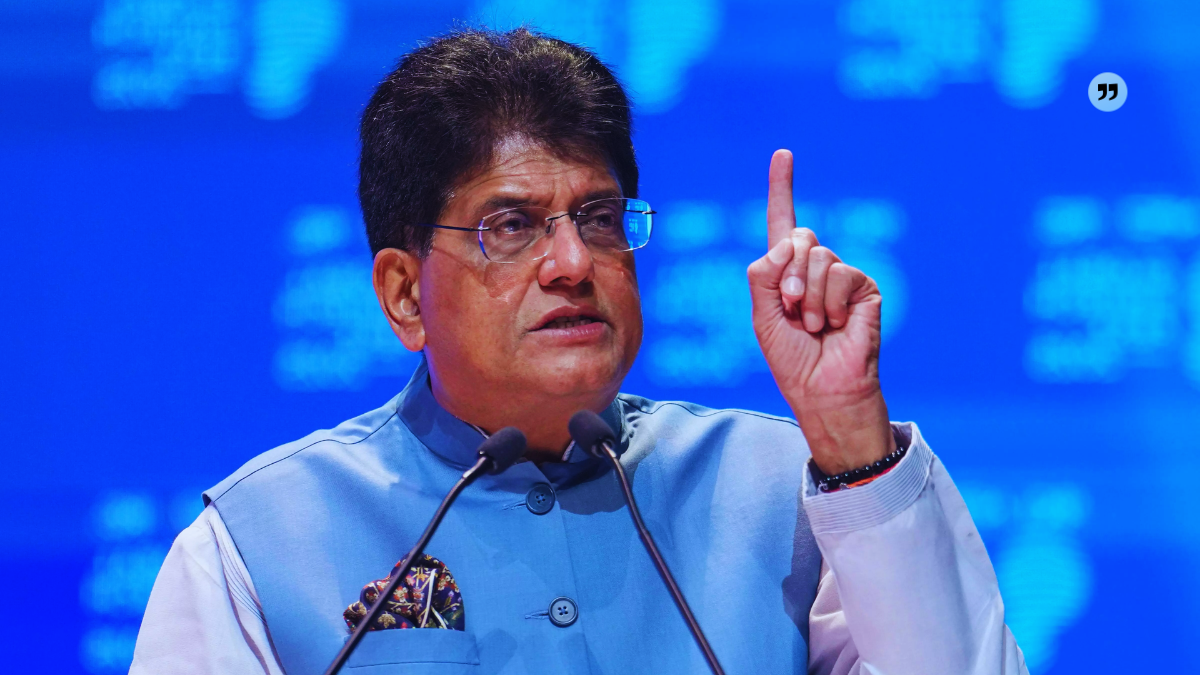
18/05/26: India wants to sell more to the world. A lot more. Commerce and Industry Minister Piyush Goyal says the country is now targeting exports worth $1 trillion this year and aims to double that figure to $2 trillion over the next five years. Big target? Absolutely. Impossible? Not anymore.
India’s export push is finally starting to sound less like ceremonial optimism and more like strategic necessity. That’s important. Because the global economy doesn’t reward sentiment. It rewards scale, speed, and execution.
The government is right to focus on FTAs, domestic manufacturing, and industrial clusters. India cannot keep aspiring to be a global power while importing critical industrial capacity from abroad. That model eventually collapses under pressure.
But targets alone won’t transform exports. Systems will.
If India genuinely wants to become a $2 trillion export economy, then compliance friction, logistics inefficiencies, port delays, financing gaps, and regulatory confusion must shrink dramatically. Indian entrepreneurs already compete globally with one hand tied behind their backs.
The opportunity exists because global supply chains are shifting away from overdependence on China. But opportunities expire. Fast.
India needs aggressive infrastructure execution, export-friendly taxation, faster approvals, and ruthless manufacturing discipline. Not motivational speeches. Not event-stage patriotism.
The countries dominating global trade today didn’t get there through slogans. They built ecosystems that made production easier than procrastination.
Are we on the right track?
India’s Export Numbers Are Climbing Despite Global Chaos

Speaking on Monday, Piyush Goyal said India’s exports have already touched $863 billion this year. That’s nearly 5 percent higher than last year despite a global economy that’s been wobbling like a shopping cart with one bad wheel.
What stands out is that both goods and services exports have grown together. Usually one carries the other. This time, both showed up to work.
The minister positioned the India export target as a defining pillar of Atmanirbhar Bharat. Not the slogan version. The actual economic version where India manufactures more, imports less, and competes harder globally.
And frankly, that’s the only version that matters.
FTAs Are Quietly Becoming India’s Trade Weapon
One of the biggest levers behind the export push is India’s aggressive Free Trade Agreement strategy.
According to Goyal, India has worked on trade agreements with nearly 38 developed countries over the last three-and-a-half years. That’s not diplomatic small talk. That’s market access.
The logic is simple.
Lower import duties in foreign markets make Indian goods cheaper compared to competitors. Cheaper products move faster. Faster movement means bigger exports.
The Oman FTA is expected to come into effect from June 1. Several other agreements are reportedly in final stages and waiting for procedural formalities before rollout.
This matters more than most people realise.
For years, Indian exporters complained that countries like Vietnam or Bangladesh got better tariff advantages in global markets. India is now trying to close that gap before global supply chains permanently move elsewhere.
Timing matters in trade. Miss the bus and you end up selling snacks outside the station.
Why Goyal Is Pushing Swadeshi Again
The minister also renewed focus on Swadeshi and domestic consumption.
His point was direct. As India’s middle class grows, demand will explode. If local industries fail to supply that demand, imports will happily fill the vacuum.
And imports don’t create Indian factories.
They create dependency.
Goyal warned that even small consumer preferences for foreign-made products weaken domestic industries over time. It’s an uncomfortable truth in a country where imported goods are often treated like status symbols.
The irony? Half those “premium” foreign products are assembled in Asia anyway. Sometimes with Indian raw materials. Branding is a powerful drug.
Still, the larger message was clear: India cannot dream of becoming a manufacturing giant while emotionally outsourcing quality perception to foreign labels.
Industrial Clusters Are Back in Focus
The government is also placing fresh attention on India’s traditional industrial hubs.
Goyal specifically named clusters such as Rajkot, Jalandhar, Ludhiana, Batala, and Pune, urging them to expand domestic production instead of relying heavily on imports, especially in capital goods.
That’s a strategic concern.
Capital goods form the backbone of industrial growth. If a country imports too much machinery, equipment, or industrial infrastructure, manufacturing strength becomes vulnerable to currency shocks, supply disruptions, and geopolitical tensions.
India learned this the hard way during pandemic-era supply chain disruptions.
Factories stalled. Components vanished. Freight costs exploded. Everyone suddenly rediscovered the meaning of “self-reliance.”
Funny how economics becomes patriotic only after containers stop arriving.
Agriculture and Fisheries Still Have Untapped Gold
Goyal also highlighted India’s agriculture and fisheries exports, which have now crossed nearly Rs 5 lakh crore.
That’s massive.
But he admitted India still struggles with value addition in these sectors. And that’s where the real money sits.
Selling raw produce earns income. Processing, packaging, branding, and manufacturing create wealth.
There’s a difference.
India exports seafood. Other countries turn seafood into premium packaged global brands. India exports fruits. Others sell processed products at triple the value.
That gap is exactly where young entrepreneurs could build billion-dollar industries.
The minister urged startups and businesses to enter value-added sectors and create processing units across small, medium, and large scales.
It’s practical advice.
India doesn’t lack raw material. It lacks enough scaling discipline.
The Real Challenge Behind the $1 Trillion Dream
The India export target sounds ambitious because it is ambitious.
But the bigger challenge isn’t crossing $1 trillion once. It’s sustaining growth consistently while global trade becomes more fragmented, protectionist, and politically tense.
The world is changing.
Countries are reshoring industries. Trade wars are becoming normal. Supply chains are increasingly tied to geopolitical alliances.
India wants to position itself as the alternative manufacturing and services hub. That opportunity is real. But so is the competition.
- Vietnam moves fast.
- China scales ruthlessly.
- Europe protects aggressively.
- America negotiates hard.
India cannot win this race with bureaucracy moving at dial-up speed.
Exporters still complain about compliance burdens, logistics bottlenecks, delayed refunds, and inconsistent policies. Infrastructure has improved, yes. But execution remains uneven across sectors.
That said, there’s finally visible momentum.
India is no longer speaking about exports like an annual government ritual. It’s being treated as an economic survival strategy.
And that changes the equation.
Because nations that produce eventually rise. Nations that consume without producing usually end up negotiating from weakness.
India appears determined not to make that mistake.

Any Comments?