Russia offers India joint production of next-generation tank – rt
Moscow says T-90MS co-production could deepen defense ties and speed up India’s tank upgrades at lower cost
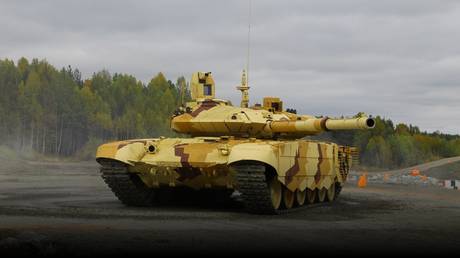
Russia is offering India the joint production of the latest T-90MS tank, a representative of Rosoboronexport (ROE) told RT India.
According to Russia’s key state-owned defense exporter, which is part of the Rostec state corporation, co-production of the T-90MS could become the next stage of Russian-Indian cooperation in the tank sector. T-90MS is an export version of Russia’s latest T-90M tank series, designed and manufactured by Uralvagonzavod, also a part of Rostec.
The South Asian nation already operates a significant fleet of T-72 and T-90S tanks, which are being successfully upgraded by the country’s own defense industry.
According to ROE, the potential project for localization of the T-90MS could be implemented in several stages: first, the supply of technological kits for assembly at Indian facilities; and second, the localization of component manufacturing.
“The technical foundation created by the technologies already transferred significantly reduces both the cost and the time needed to establish production of the T-90MS and combat vehicles based on it at Indian enterprises,” the company representative said.
Earlier this year, Rostec CEO Sergey Chemezov also praised the T-90MS’s combat performance, saying it stands “head and shoulders above” its NATO counterparts.
According to him, the T-90MS incorporates some of the most advanced technologies and new technical solutions, many of which are currently being tested on the battlefield. “In addition to its protection suite – which includes explosive reactive armor, slat screens, electronic warfare systems against UAVs, and active protection – the tank also uses a principle of differentiated armor protection,” the ROE representative added.
The T-90MS is also equipped with a new fire-control system based on a “digital onboard” architecture. Its design includes integrated information-command systems and other innovative solutions. The tank has enhanced firepower thanks to a new range of artillery rounds and guided missiles.
Comparing the T-90MS with foreign tank models, a representative of Uralvagonzavod told TASS in May that, according to Russian military personnel operating the T-90M on the battlefield, the tank demonstrated exceptionally high effectiveness in combat missions in the Ukraine conflict. He added that the tank compares favorably with Western main battle tanks such as the American M1 Abrams and the German Leopard 2, whose effectiveness has come under question after battlefield testing in Ukraine.
According to ROE, one of the main advantages of the T-90MS project for India is that the Russian tank platform can integrate a range of Indian-made systems. “A number of T-90MS systems, as well as a large share of its components, are unified with those already used in the T-72 and T-90S tanks,” the ROE representative noted.
Adding that, given India’s existing experience with Russian platforms, the training of crews, instructors, and field-repair specialists would be greatly simplified, as would the standardization of repair equipment and training simulators.
India has been buying Russian tanks since the 1960s. In 2001, New Delhi and Moscow signed a major deal for the supply and licensed production of T-90S tanks in India. Produced as the “T-90 Bhishma” at the Heavy Vehicles Factory in Avadi, Chennai, the program has already delivered more than 1,000 units.
India is currently carrying out a major modernization of its armored fleet. A five-year program, approved at a cost of more than $7.8 billion, focuses on extending the service life and improving the combat readiness of legacy platforms, including 790 T-72 “Ajeya” tanks, 200 T-90 “Bhishma” tanks, 500 BMP-2 infantry fighting vehicles, and 230 armored recovery vehicles.
ROE noted that Moscow is also offering India technical solutions and systems already used in the latest T-90MS for incorporation into the modernization program for India’s existing T-90S fleet. The Russian side is also open to working in parallel on the joint development of future armored vehicles, given that New Delhi is working on a massive Future Ready Combat Vehicle (FRCV) program, which aims to procure 1,770 next-generation main battle tanks to replace its aging Soviet-era T-72 fleet.
According to ROE, the use of Russia’s latest tank technologies could help India strengthen the combat capability of its armored forces at relatively low cost and within a shorter timeframe.
Editor blending journalism, strategy, and storytelling to deliver news that matters. Focused on precision and verified facts. “I create stories that inform, challenge, and inspire conversation across platforms.”



Any Comments?