
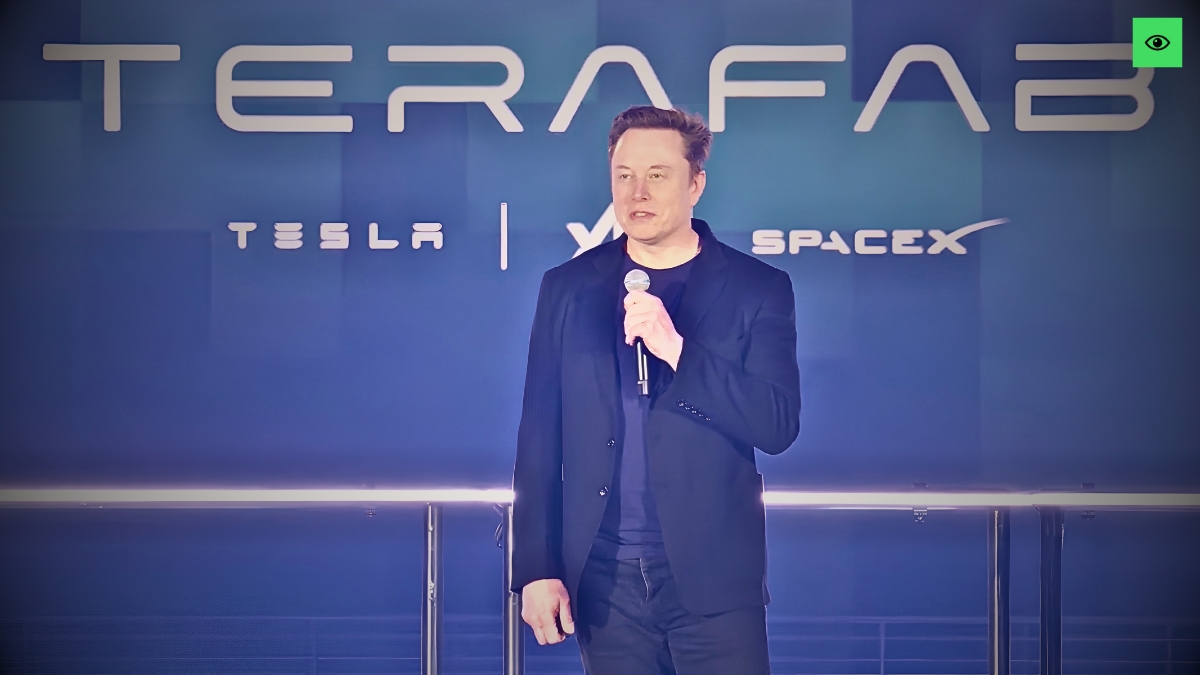
06/08/2026: Tesla and SpaceX have picked Texas for a semiconductor project of almost absurd proportions.
The two Elon Musk-led companies said Thursday that Tesla SpaceX Terafab, their jointly developed advanced chip manufacturing facility, will be built in Grimes County, outside Houston. The initial investment: $16.8 billion.
And apparently, “big factory” doesn’t quite cover the ambition here.

Tesla and SpaceX are treating semiconductor capacity as strategic infrastructure rather than another component to purchase from suppliers. That logic is difficult to dismiss.
But industrial ambition and public accountability cannot become mutually exclusive. If communities are providing tax incentives, residents deserve transparent numbers, environmental clarity and measurable economic commitments.
India should absorb the strategic lesson without blindly copying the spectacle. The semiconductor race will not be won by announcing the biggest factory. It will be won by building dependable ecosystems around fabrication, packaging, specialised chip design, talent, energy and domestic demand.
The future may run on AI. AI still runs on hardware. Whoever forgets that rather inconvenient fact will eventually discover it the expensive way. – @shiven3197
Elon Musk, CEO of both Tesla and SpaceX, described Terafab in a Thursday post as being destined to become “the largest and most valuable building on Earth by far.”
SpaceX says more than 100 million square feet of manufacturing space is planned.
That number deserves a second read.
More than 100 million square feet.
This isn’t merely another semiconductor plant being added to America’s industrial map. Tesla and SpaceX are proposing a vertically integrated manufacturing operation designed around an uncomfortable reality of the AI boom: everybody wants more compute, but somebody still has to manufacture the physical chips behind it.
And Musk’s companies intend to manufacture a lot of them.
Tesla SpaceX Terafab Targets the Compute Bottleneck
SpaceX describes Terafab as an advanced semiconductor fabrication facility designed to bridge the gap between existing global chip supply and future computing demand.
That demand sits at the heart of Musk’s broader technological ambitions.
Tesla is developing Optimus humanoid robots and autonomous Cybercabs. SpaceX, meanwhile, has floated plans involving satellites functioning as space-based data centres for AI training and inference.
Different machines. Same appetite.
Compute.
If millions of robots are eventually deployed, autonomous vehicles perform increasingly sophisticated workloads, and orbital infrastructure starts handling AI computation, the required semiconductor capacity becomes enormous.
Buying chips from somebody else works until supply becomes the constraint.
Terafab appears designed to attack that constraint directly.
SpaceX says the facility will manufacture, package and test advanced logic and memory devices under one gigantic roof.
The company argues that combining these processes in one location should allow faster, recursive improvements while accelerating the deployment of new computing hardware.
In plain English: design, build, test, improve, repeat.
Faster.
More Than 100 Million Square Feet of Manufacturing
Scale is arguably the most striking part of the Tesla SpaceX Terafab announcement.
SpaceX says the vertically integrated factory is planned with more than 100 million square feet of manufacturing space.
Terafab would house semiconductor manufacturing alongside packaging and testing operations, bringing critical stages of chip production together at one site.
SpaceX says Terafab will manufacture chips optimised for edge computing and inference.
Tesla would have obvious applications for those processors.
The company’s Optimus humanoid robots need substantial onboard computing capabilities. Tesla’s self-driving Cybercabs would similarly require specialised hardware capable of processing information quickly enough for autonomous operation.
SpaceX has another destination in mind.
Orbit.
According to the company, Terafab would also produce high-power chips intended for SpaceX’s planned space-based data centres.
So this factory isn’t being pitched around one product line.
It is being built around an ecosystem of compute-intensive ambitions spanning cars, robots, artificial intelligence and satellites.
The Investment Could Go Far Beyond $16.8 Billion
The announced initial investment is already enormous at $16.8 billion.
But that might only be the opening cheque.
SpaceX has suggested in filings that spending connected to the project could eventually reach as much as $119 billion through a multi-phase construction plan.
There is an important distinction here.
The $16.8 billion figure is the initial investment announced by Tesla and SpaceX. The $119 billion figure represents what SpaceX has suggested it may spend across the broader multi-phase project.
That difference matters.
Interestingly, SpaceX did not discuss Terafab during its first earnings call earlier this week, despite the potential scale of the investment.
Intel has also said it will contribute to the Terafab project.
Exactly what Intel will contribute remains unclear.
For now, therefore, Intel is part of the story, but the precise technological, manufacturing or financial scope of its involvement has not been detailed.
At Least 3,000 Local Jobs
Tesla and SpaceX say the facility will employ at least 3,000 people from Grimes County and neighbouring Brazos County.
That gives the project an immediate local economic dimension beyond its eye-catching investment figures.
Large semiconductor facilities require much more than fabrication equipment. They need engineers, technicians, manufacturing workers, maintenance teams and supporting infrastructure.
But projects of this size rarely arrive without friction.
And Terafab is no exception.
Texas Residents Raise Questions Over Tax Breaks
The announcement came after a heavily attended county meeting on Wednesday.
Hundreds of residents showed up.
Their concerns included millions of dollars in tax breaks awarded to the project and what residents described as a lack of transparency surrounding the development.
That creates a familiar tension.
Local governments want investment, jobs and long-term economic activity. Residents want to know precisely what their communities are giving up in return, particularly when public incentives are involved.
A $16.8 billion initial investment certainly makes an impressive headline.
Tax concessions deserve scrutiny too.
Both things can be true simultaneously.
Anderson-Shiro Consolidated Independent School District Superintendent Dr. Sarah Borowicz said the agreement could strengthen the district, expand opportunities and better prepare students for the future.
She also stressed that opportunities generated through the agreement must be managed wisely and transparently, with students kept at the centre of decisions.
That word matters here.
Transparency.
Because industrial ambition doesn’t eliminate the obligation to explain public incentives to the people affected by them.
Water Supply Gets Special Attention
Semiconductor manufacturing also brings another critical resource into the conversation: water.
Chip fabrication can require substantial quantities of it, making water sourcing a significant issue for surrounding communities.
SpaceX says Terafab is committing to using water from the local Gibbons Creek Reservoir rather than relying on local groundwater.
That commitment directly addresses one potential pressure point as construction and manufacturing operations scale.
For a project this enormous, however, infrastructure questions will remain central.
A facility exceeding 100 million square feet cannot simply appear on a map.
It requires energy, water, transportation, workers, logistics and an industrial ecosystem capable of supporting manufacturing at extraordinary scale.
Why Terafab Matters Beyond Tesla and SpaceX
Strip away the Musk factor for a moment.
Terafab represents something bigger than another Tesla or SpaceX expansion.
It is a bet on vertical integration at the semiconductor level.
Tesla has already pushed vertical integration across software, batteries, vehicle manufacturing and AI computing. SpaceX has similarly built much of its technological stack internally.
Terafab pushes that philosophy deeper.
Into the chips themselves.
If Tesla and SpaceX can manufacture specialised processors tailored to their own workloads, they potentially gain tighter control over one of the most strategically important components of the AI economy.
For Tesla, that means computing hardware designed around robots and autonomous vehicles.
For SpaceX, it means high-power processors built around an entirely different environment: space.
The common denominator is no longer merely transportation.
It is computation.
An Indian Perspective: The Semiconductor Race Is Getting Serious
India should watch developments such as Tesla SpaceX Terafab carefully.
Not because India needs to copy a 100-million-square-foot American megafactory.
It doesn’t.
The larger lesson is strategic.
Semiconductors increasingly sit underneath artificial intelligence, defence systems, telecommunications, autonomous machines, cloud infrastructure, consumer electronics and advanced manufacturing.
The countries and companies capable of controlling more of that stack gain resilience.
India has already recognised semiconductor manufacturing as strategically important. Projects like Terafab reinforce why the race isn’t simply about manufacturing today’s chips.
The next battle is over specialised computing.
AI inference chips. Edge processors. Memory. Packaging. High-performance computing.
The boring little rectangle of silicon is becoming geopolitical infrastructure.
Funny how quickly “hardware” became national strategy.
Terafab Is Really a Bet on Musk’s Version of the Future
Ultimately, the Tesla SpaceX Terafab project only makes sense at this scale if Musk’s companies believe computing demand will explode.
That is precisely the bet being made.
Millions of robots.
Autonomous transportation.
AI inference everywhere.
Satellites handling computation in orbit.
Whether every part of that vision materialises exactly as imagined is unknowable today.
What is factual is the industrial response already being planned.
Tesla and SpaceX are putting an initial $16.8 billion behind Terafab. SpaceX has suggested the broader multi-phase project could involve spending of up to $119 billion. More than 100 million square feet of manufacturing space is planned, and at least 3,000 local jobs are expected.
That isn’t a prototype.
It is infrastructure.
And if Terafab reaches the scale its developers envision, Musk won’t merely be building cars, rockets, robots and satellites. His companies will increasingly be building the computational foundation underneath them too.

Any Comments?