
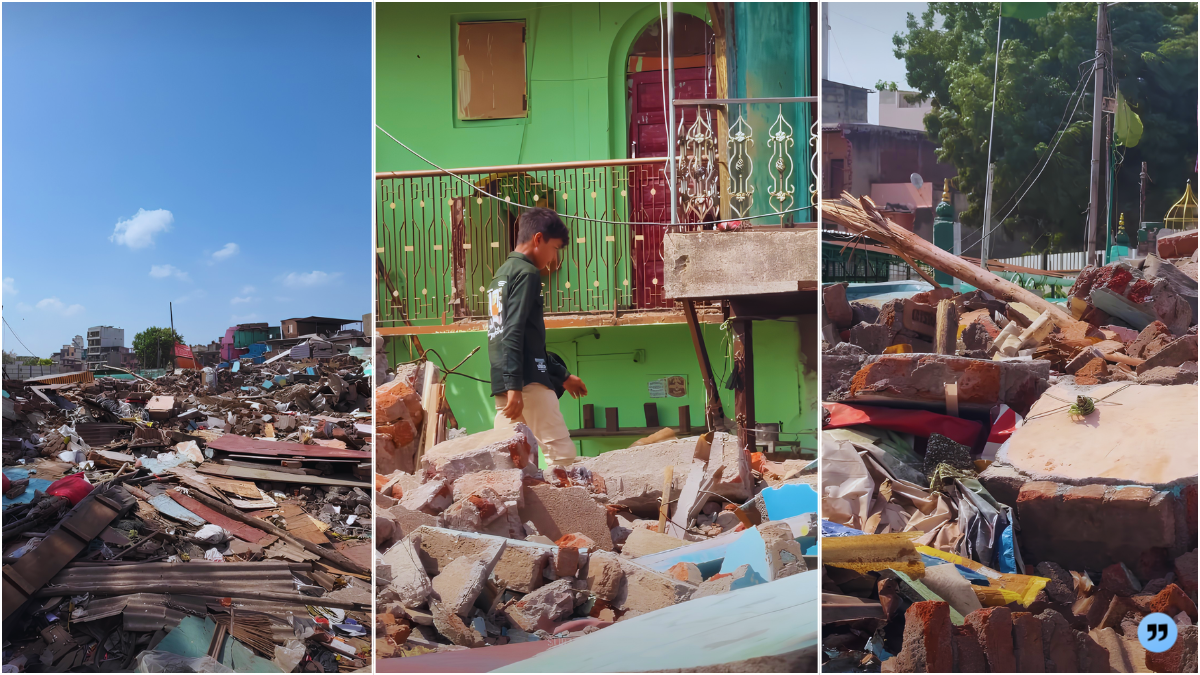
09/06/26: The Surat Ghost Demolition controversy is rapidly becoming one of the city’s most explosive civic disputes. Nearly 100 homes in Katargam’s Nasirnagar settlement were reduced to rubble, yet days later, no authority has officially accepted responsibility for ordering or executing the demolition.
The story sounds almost impossible. A large-scale demolition operation takes place in broad daylight. Bulldozers move in. Homes are flattened. Municipal officials are present. Police personnel are on site. Families watch their belongings disappear under debris.
And yet, nobody claims ownership of the operation.
That is precisely the question now confronting Surat.
Residents of Nasirnagar, located in the Katargam area, are demanding answers after nearly 100 houses were allegedly demolished on May 30. The operation displaced dozens of families and triggered widespread criticism from political leaders, civil society groups and local residents.
What makes the controversy extraordinary is that every institution present during the demolition has distanced itself from the action.
Surat Municipal Corporation Denies Issuing Demolition Order
The Surat Municipal Corporation has maintained that it did not authorise any demolition in the area.
According to BJP MLA Vinu Mordia, senior officials informed him that the municipal team had only visited Nasirnagar for legal line marking and road margin measurements.
“The information provided by the officials is shocking. The municipal team had gone there only for legal line drawing and road margin measurements. No demolition order was issued, no official action was sanctioned, and there is no record of such a drive in the municipal files,” Mordia stated.
The statement immediately raised a larger question.
If the civic body did not order the demolition, who did?
Municipal records reportedly contain no official documentation approving such an exercise. No publicly available demolition notice has been produced. No civic department has accepted responsibility.
For many observers, that explanation only deepens the mystery.
The ‘Ghost Demolition’ Theory Gains Ground
As conflicting explanations emerged, the incident began attracting a nickname that quickly spread across local discussions.
Residents and political observers started calling it a “ghost demolition.”
The phrase reflects a troubling reality. A major demolition occurred, yet the chain of command remains unclear.
Heavy machinery including JCB and Hitachi equipment reportedly entered the settlement and cleared structures across a large area. Such operations generally require coordination, planning and administrative oversight.
Yet officials continue to deny any direct involvement.
Mordia questioned how an entire settlement could disappear in broad daylight without official sanction.
“If the Municipal Corporation did not carry out this demolition, then who had the courage to wipe out an entire slum settlement?” he asked.
The MLA has demanded a thorough investigation into those responsible.
Police Presence Raises Fresh Questions
Residents allege that police personnel remained present throughout the demolition process.
The role of law enforcement has become another major point of contention.
According to local resident Javid Shah, families desperately sought intervention while bulldozers moved through the settlement.
“When the JCB claws were tearing through houses and women and children were crying to save their homes, policemen in uniform were standing there. If this demolition was illegal, why did the police not ask for a demolition order or a magistrate’s permission?” Shah questioned.
The allegation has intensified scrutiny on police conduct during the operation.
Critics argue that if the demolition lacked proper authorization, officers present at the scene should have verified documentation or intervened to prevent potentially unlawful action.
Questions are now being raised regarding the role of PCR teams, supervisory officers and personnel deployed at the location.
Municipal Commissioner Suggests Private Party Involvement
Municipal Commissioner M. Nagarajan offered a different explanation.
According to him, the SMC team had visited the area only for a demarcation exercise connected to a long-pending land issue.
“During that time, some structures were demolished by another party. The land belongs to a private entity, and they may have deployed machinery. The SMC has no role in the demolition,” Nagarajan said.
That statement has shifted attention toward possible private involvement.
However, it has also generated new concerns.
If a private party carried out the demolition, how did such a large-scale operation proceed in the presence of civic officials and police personnel without immediate intervention or verification?
That question remains unanswered.
Land, Development and Growing Speculation
The controversy has inevitably triggered speculation regarding possible development interests linked to the land.
Reports suggest that structures were cleared to facilitate road access connected to a private project located behind the settlement.
At present, no evidence has been publicly presented establishing wrongdoing by any developer or private entity.
However, the circumstances have fuelled debate around property rights, land disputes and administrative accountability.
In a city where even minor unauthorised constructions often attract rapid municipal enforcement, residents are questioning how nearly 100 homes could be demolished without a clearly documented government order.
The contrast has become difficult for many to ignore.
Inquiry Ordered as Pressure Mounts
The SMC Standing Committee has acknowledged the seriousness of the issue.

Standing Committee Chairman Rajan Patel confirmed that the civic body has ordered a detailed investigation.
According to officials, senior officers will now attempt to determine who carried out the demolition and whether any laws or procedures were violated.
Political pressure is also increasing.
Opposition voices, local activists and community leaders continue demanding transparency. The issue has expanded beyond Nasirnagar and become a broader debate about governance, oversight and institutional accountability.
For the displaced families, however, the discussion remains deeply personal.
Many have lost homes accumulated over years. Furniture, documents and household belongings reportedly remain buried beneath rubble.
While politicians debate responsibility and departments exchange explanations, residents continue searching for certainty.
The Surat Ghost Demolition case presents a remarkable administrative puzzle. Nearly 100 homes were demolished. Bulldozers operated openly. Municipal officials and police personnel were present. Yet no agency has formally accepted responsibility for authorising the action.
Whether the inquiry points toward administrative negligence, procedural failure or unauthorized action by private actors remains to be seen.
Until then, one uncomfortable fact remains standing amid the debris.
Almost 100 homes disappeared in Surat, and the city still does not know who ordered the bulldozers.
Governments function through paperwork, authorisation, records and responsibility. A demolition involving nearly 100 homes cannot simply appear out of nowhere. Somebody requested it, somebody coordinated it, somebody deployed machinery and somebody allowed it to continue.
The most logical solution is complete transparency. Every official present at the site should provide a written account of their role. Vehicle movements, machinery ownership, deployment records and communication logs should be examined. If procedures were followed, authorities should show the documents. If procedures were ignored, responsibility should be fixed quickly.
The real danger is not merely the loss of homes. The real danger is creating a precedent where large-scale actions occur without a clearly identifiable decision-maker. In any democracy governed by law, accountability cannot become optional simply because responsibility becomes inconvenient. – ARM THE OPINION
Leave a Mark