
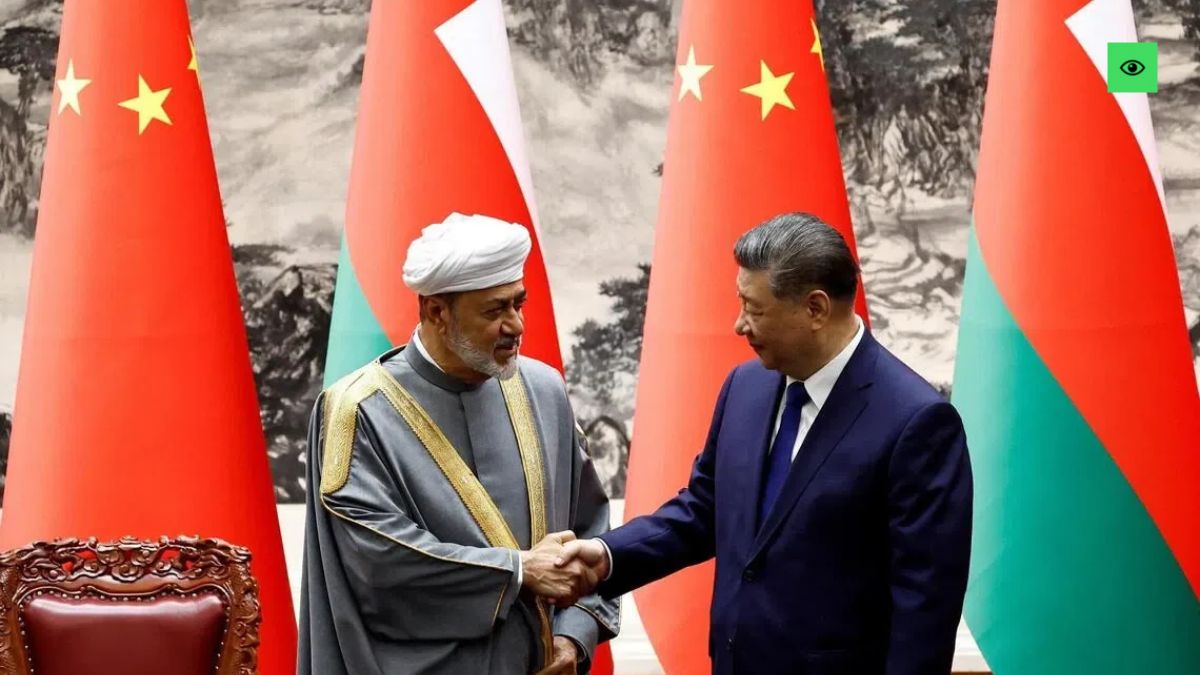
MUSCAT, 2nd Nov: China is stepping up its diplomatic push in the Middle East. President Xi Jinping has told Oman’s Sultan Haitham bin Tariq al-Said that the Gulf must not become a battleground for great-power rivalry, calling for collective efforts to restore peace and stability.
The message comes as the US-Israeli war on Iran continues to disrupt the Strait of Hormuz, pushing up global energy and shipping costs. Beijing wants a bigger role in easing regional tensions. And Oman, a key Gulf partner, is part of that effort.
China Oman Peace Talks: Xi Rejects Great-Power Rivalry
During talks with Sultan Haitham on November 2, Xi said the Middle East Gulf region should not become an arena for geopolitical conflict.
According to China’s Foreign Ministry, Xi argued that peace and stability require joint nurturing and protection by all parties.
He also pointed to the scale of global change, saying the world is experiencing “profound changes unseen in a century”.
The message was clear. China does not want the Gulf to become another front in the contest between major powers.
Xi said China remains committed to stopping the war and hopes to contribute “wisdom and solutions” to the region’s security dilemmas.
Beijing has traditionally maintained a relatively low-key diplomatic presence in the Middle East. That approach, however, is changing as the conflict threatens regional stability and international commerce.
The Strait of Hormuz is a critical concern. Disruptions there have already snarled shipping and driven up energy costs worldwide. For countries dependent on energy imports, the consequences extend far beyond the Gulf.
China is now seeking to strengthen its diplomatic engagement while working with Arab nations to prevent further escalation.
Beijing Wants a Bigger Role in Gulf Security
Xi said China was willing to strengthen communication and coordination with Arab countries, including members of the Gulf Cooperation Council.
The objective is to work together towards restoring peace and achieving lasting stability and security.
That commitment comes with a concrete diplomatic move.
Last week, China’s Foreign Ministry announced that Beijing would soon dispatch special envoys to the Middle East to promote engagement and de-escalation.
The move signals a more active Chinese effort to address regional tensions.
For Beijing, the challenge is not simply to call for peace. The region’s security problems involve competing interests, geopolitical pressure and the economic consequences of conflict.
China’s proposed approach centres on communication, coordination and peaceful resolution.
Whether those efforts can deliver tangible results remains to be seen. But the diplomatic push indicates that Beijing wants a seat at the table as the Gulf’s future is debated.
Oman and China Strengthen Strategic Relations
Sultan Haitham arrived in Beijing on November 1 for a two-day visit.
It marks the first visit by an Omani head of state to China since the two countries established diplomatic relations in 1978.
The meeting carries significance beyond the immediate regional crisis.
Oman has expressed strong appreciation for China’s positions on key regional issues, according to Omani state media.
Haitham told Xi that development and stability were inextricably linked.
He also stressed that national prosperity requires security, peace, respect for state sovereignty and adherence to international law.
His position was straightforward: disputes should be resolved through peaceful means.
That message aligns with Xi’s call for collective efforts to protect Gulf stability.
Oman’s role is especially relevant as China seeks deeper engagement with Arab nations. The visit gives both sides an opportunity to discuss regional security alongside economic cooperation.
China Oman Trade Deal Could Open New Opportunities
The diplomatic discussions also brought economic cooperation into focus.
Haitham said Oman was open to entering into a preferential bilateral trade and investment agreement with China.
He expressed confidence that such an agreement would create new avenues for trade and investment while improving commercial and investment exchanges between the two countries.
China is already Oman’s largest trade partner.
The relationship is supported by energy exports, business links and tourism. Direct flights between Beijing and Muscat have operated since November 2025, further strengthening connectivity.
Oman exports crude oil and energy products to China. At the same time, the Gulf nation is looking to develop its renewable energy supply chains and digital commerce.
That creates room for cooperation beyond traditional energy trade.
A preferential agreement could provide a framework for expanding commercial engagement. However, the proposal remains an expression of willingness, not a concluded deal.
The two countries have established a strong economic foundation. The next question is how far they can extend it.
Financial Cooperation Adds Another Dimension
Haitham’s visit also highlighted cooperation between investment and financial institutions.
The Omani leader was welcomed on the tarmac in Beijing by People’s Bank of China Governor Pan Gongsheng.
His presence underscored the financial dimension of the relationship.
Trade, investment and financial cooperation are increasingly central to the discussions between Beijing and Muscat.
For Oman, stronger ties with China could support its ambitions in renewable energy supply chains and digital commerce.
For China, the relationship offers another avenue for engagement with the Gulf, a region whose energy flows and security conditions have global consequences.
The economic agenda and the diplomatic agenda are closely connected. Stability creates conditions for trade, while stronger commercial relationships can deepen cooperation between countries.
That is the logic behind the discussions.
What Xi’s Gulf Message Means
China’s latest diplomatic push comes at a time when the Middle East is facing serious security and economic pressures.
The war involving the US, Israel and Iran has disrupted the Strait of Hormuz and increased global energy and shipping costs. The consequences are being felt well beyond the region.
Xi’s call for peace reflects Beijing’s interest in preventing the Gulf from becoming a prolonged arena of geopolitical confrontation.
Oman’s willingness to deepen economic ties adds another layer to the relationship.
The two countries are discussing regional stability, trade, investment and financial cooperation within the same diplomatic engagement.
For now, China is positioning itself as a partner willing to work with Arab nations on de-escalation.
The real test will be whether diplomatic engagement can help reduce tensions and protect the region from further instability.
Peace in the Gulf is not merely a regional concern. It matters to global energy markets, shipping networks and economies that depend on both.
And that is precisely why Xi’s message deserves attention.

Any Comments?