
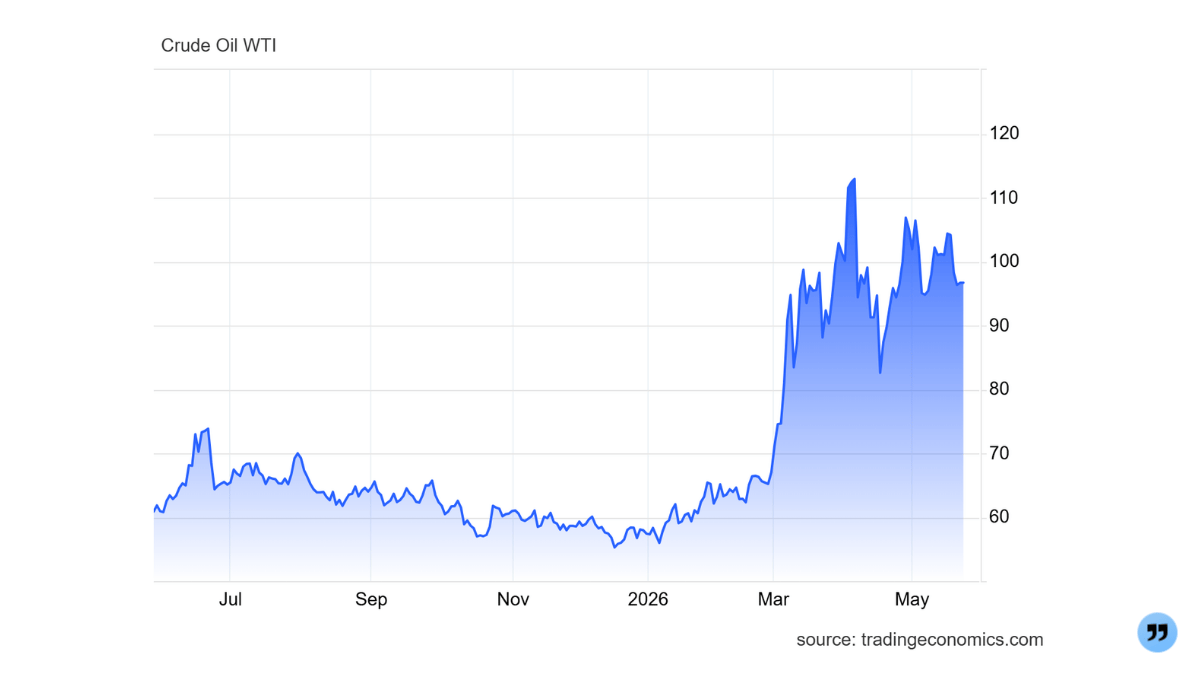
22/05/26: Oil prices are back in the global spotlight. Again. One missile threat near the Strait of Hormuz and traders start behaving like caffeine-powered squirrels on Wall Street. Brent crude surged above $110 per barrel before cooling, but the real story isn’t just the price spike. It’s who quietly profits while everyone else panics.
The Middle East conflict has once again exposed how fragile global energy markets really are. And while oil producers may enjoy the short-term fireworks, the smartest money is flowing somewhere far less glamorous: pipelines.
The market obsession with oil price spikes misses the real power structure inside global energy. The companies with actual leverage are not necessarily the ones drilling oil. It’s the ones controlling movement, storage, and infrastructure. Pipelines rarely become headline material because they’re boring. That’s exactly why they’re valuable.
The bigger issue is how dangerously dependent the global economy remains on a handful of geopolitical choke points. Every few years, markets act shocked that the Strait of Hormuz can destabilize global trade. Then politicians give speeches. Analysts create dramatic charts. Nothing fundamentally changes.
Countries serious about energy security need diversified supply chains, stronger domestic reserves, and long-term infrastructure investment instead of ideological theater. Energy transition is fine in theory. But pretending oil dependency disappeared because social media got louder is economic fantasy.
Reality always wins eventually. Usually with a very expensive invoice.
Oil Prices Jump as Hormuz Tensions Return

Crude oil markets have been moving like a heartbeat monitor over the last two weeks. Brent crude briefly crossed $110 per barrel after fears emerged around possible disruptions in the Strait of Hormuz, one of the world’s most critical oil shipping routes.
The panic wasn’t irrational. Roughly one-fifth of global oil supply moves through that narrow waterway. Any disruption there sends shockwaves across shipping, refining, aviation, and manufacturing. Fast.
But then came a slight cooldown.
Improved tanker movement through the region helped calm nerves temporarily. Diplomatic talks between the United States and Iran also hinted at possible progress. That optimism faded almost immediately after fresh comments from Iran regarding uranium stockpiles and shipping conditions reignited uncertainty.
Classic geopolitical whiplash. Markets love that.
Brent crude recovered above $104 per barrel by Friday, while West Texas Intermediate edged toward $98. Despite the rebound, Brent still remained more than 4% lower for the week.
The Strait of Hormuz Still Holds the Global Economy Hostage
The Strait of Hormuz isn’t just another shipping lane. It’s the artery pumping energy into global economies.
Even now, shipping activity remains below pre-conflict levels. However, multiple crude carriers and LNG tankers have reportedly resumed movement toward Asia. That matters because markets don’t need perfection. They just need signs that trade hasn’t completely collapsed.
According to Julius Baer economist Norbert Rücker, the oil market currently resembles a geopolitical tug of war between military risk and economic reality.
He’s not wrong.
Countries dependent on Gulf oil don’t have the luxury of ideological purity. China, South Korea, and several Asian buyers still need energy. Iran still needs revenue. Gulf exporters still need functioning trade routes. Money has a funny habit of forcing diplomacy when politicians fail.
And that’s exactly why tanker movement is slowly recovering.
Why Midstream Energy Companies Keep Winning
Here’s where things get interesting.
Most investors obsess over upstream oil producers whenever crude prices jump. Companies like Diamondback Energy benefit directly because higher oil prices mean fatter profits. Simple equation.
But upstream businesses live and die by commodity prices. What rises violently can also collapse violently.
Midstream companies play a different game entirely.
Energy Transfer, Enterprise Products Partners, and Kinder Morgan don’t care much whether oil trades at $60 or $110. They make money by transporting energy through pipelines, terminals, and storage systems. They’re essentially toll booths for global energy demand.
Boring? Absolutely.
Profitable? Extremely.
Energy Transfer reported rising energy volumes across its infrastructure network during the first quarter of 2026. Distributable cash flow jumped nearly 17% year-over-year, strong enough for management to raise full-year guidance.
Enterprise Products Partners posted record volumes across several divisions and increased distributable cash flow by 5%. Kinder Morgan also delivered strong quarterly numbers driven by stable transport demand.
None of these companies needed an oil price explosion to succeed. That’s the point.
Stable Cash Flow Beats Commodity Drama
The market often rewards chaos in the short term. Long-term wealth usually comes from infrastructure.
Energy Transfer currently offers a distribution yield above 6.6%. Enterprise Products Partners sits around 5.5%. Kinder Morgan pays roughly 3.4%.
These businesses operate like energy highways. As long as oil and natural gas keep moving, revenue keeps flowing.
That’s especially important now because geopolitical instability may actually increase long-term demand for North American energy exports.
Countries watching Middle East tensions unfold are quietly reassessing energy security. Reliable supply suddenly matters more than political speeches about transition timelines.
And North America looks relatively stable compared to conflict-prone export regions.
Global Oil Reserves Are Shrinking Faster Than Expected
The world maintains strategic oil reserves to cushion temporary supply disruptions. Think of them as emergency backup batteries for the global economy.
Problem is, those batteries are draining.
The reserve buffer once covered around 80 days of supply shocks. That cushion has steadily declined. If a prolonged disruption occurs, markets may not have enough reserve protection to prevent severe volatility.
That reality explains why traders react aggressively to every headline involving Iran, shipping lanes, or military escalation.
Still, there’s an important distinction.
Current market conditions resemble previous geopolitical oil shocks more than a permanent supply collapse. Historically, oil spikes triggered by conflict tend to be intense but temporary.
That’s exactly what analysts like Rücker expect this time as well.
The US Has Quietly Become the World’s Emergency Oil Supplier
One underreported shift in global energy markets is America’s growing role as the supplier of last resort.
US exports of crude oil and refined products have reportedly climbed sharply since April. Those exports are helping stabilize shortages across global markets while simultaneously reducing domestic storage levels.
In simple terms, America has become the emergency backup generator for global oil demand.
That’s not ideological. That’s logistics.
Even Europe’s earlier fears around jet fuel shortages have started easing as refining systems stabilize and shipping routes improve.
Ironically, while politicians debate energy transition targets on conference stages, the real global economy is still desperately dependent on oil infrastructure.
Factories don’t run on hashtags. Cargo ships don’t move on climate panels. Reality remains stubbornly industrial.
Is the Oil Crisis Nearing Its Peak?
Maybe. Maybe not.
The biggest danger now would be direct damage to critical infrastructure or a prolonged conflict severe enough to crush economic demand through sustained high prices.
So far, that hasn’t happened.
Trade routes are adapting. Tanker movement is recovering gradually. Global inventories still provide some breathing room. And markets are adjusting faster than many expected.
That doesn’t mean stability has returned. Far from it.
It simply means the oil market has entered survival mode rather than collapse mode.
And if history repeats itself, this current oil shock may eventually fade into another chapter of temporary geopolitical panic followed by normalization.
Until the next crisis arrives. Because in energy markets, there’s always a next crisis.

Leave a Mark